• Surviving Pharloom is ultimately about making smart use of the resources you have, and that mindset carries over to how I buy games between runs. I like to check cheapest steam keys(https://dealnesthq.com/ ) at DealNest when I want to add another metroidvania or indie challenge to my backlog without overspending, so I can save my budget for the games I really want to play next.
    Surviving Pharloom is ultimately about making smart use of the resources you have, and that mindset carries over to how I buy games between runs. I like to check cheapest steam keys(https://dealnesthq.com/ ) at DealNest when I want to add another metroidvania or indie challenge to my backlog without overspending, so I can save my budget for the games I really want to play next.
    0 Reacties 0 aandelen 323 Views
  • Protective Coating Market Analysis by Types, Applications, and Regions

    Protective Coating Market to Reach USD 26.27 Billion by 2034, Driven by Infrastructure Development and Industrial Demand

    Global Protective Coating Market Overview

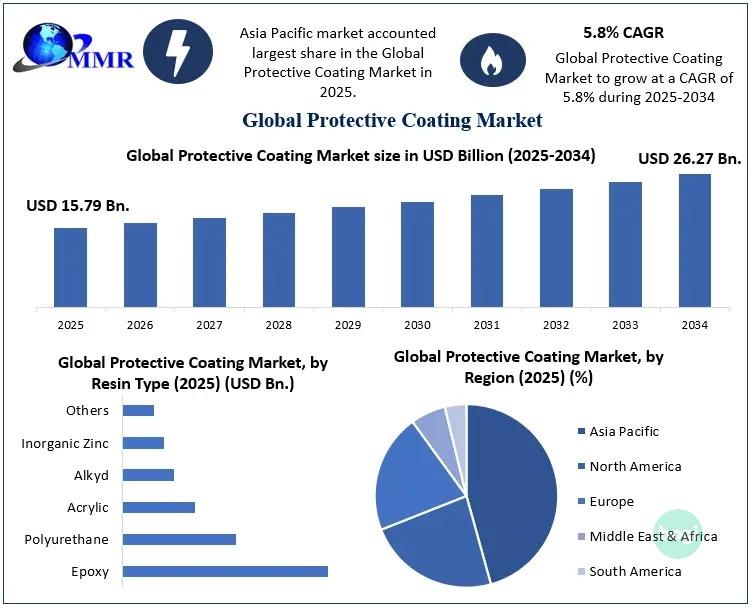
    The Protective Coating Market is witnessing steady expansion as industries increasingly prioritize corrosion prevention, infrastructure durability, equipment protection, and long-term asset maintenance. According to Maximize Market Research, the market was valued at USD 15.79 billion in 2025 and is projected to reach USD 26.27 billion by 2034, registering a CAGR of 5.8% during 2025–2034. The growing requirement for advanced coating solutions across construction, oil and gas, marine, automotive, mining, and power generation industries is supporting market expansion.

    Protective coatings are specialized materials applied to surfaces to protect them against corrosion, moisture, chemicals, abrasion, extreme temperatures, and environmental degradation. Their increasing adoption is helping industries extend equipment lifespans, reduce maintenance expenditure, improve operational efficiency, and minimize unexpected production shutdowns.

    Market Estimation, Growth Drivers, and Opportunities

    The market's growth is primarily supported by increasing infrastructure investments, rapid industrialization, and the modernization of aging industrial assets. Governments across major economies are investing in transportation networks, bridges, commercial buildings, energy infrastructure, and water management facilities, creating substantial demand for high-performance protective coatings.

    The oil and gas industry represents another important growth opportunity because pipelines, offshore platforms, storage tanks, and processing facilities require specialized coatings to withstand corrosive environments and harsh operating conditions. Similarly, expanding marine transportation, shipbuilding, renewable energy installations, and manufacturing activities are increasing the consumption of protective coating materials.

    Technological advancements in epoxy, polyurethane, acrylic, and zinc-rich coatings are creating additional opportunities. Manufacturers are increasingly developing water-based, low-VOC, high-solids, and powder-based formulations to comply with environmental regulations while maintaining superior protection. Growing demand for sustainable materials, longer coating lifecycles, and reduced maintenance requirements is expected to create attractive opportunities for manufacturers throughout the forecast period.

    However, fluctuating raw material prices, energy costs, and stringent environmental compliance requirements remain important challenges for market participants.

    Get a Sample Insight Report Now : https://www.maximizemarketresearch.com/request-sample/32616/
    Protective Coating Market Analysis by Types, Applications, and Regions Protective Coating Market to Reach USD 26.27 Billion by 2034, Driven by Infrastructure Development and Industrial Demand Global Protective Coating Market Overview The Protective Coating Market is witnessing steady expansion as industries increasingly prioritize corrosion prevention, infrastructure durability, equipment protection, and long-term asset maintenance. According to Maximize Market Research, the market was valued at USD 15.79 billion in 2025 and is projected to reach USD 26.27 billion by 2034, registering a CAGR of 5.8% during 2025–2034. The growing requirement for advanced coating solutions across construction, oil and gas, marine, automotive, mining, and power generation industries is supporting market expansion. Protective coatings are specialized materials applied to surfaces to protect them against corrosion, moisture, chemicals, abrasion, extreme temperatures, and environmental degradation. Their increasing adoption is helping industries extend equipment lifespans, reduce maintenance expenditure, improve operational efficiency, and minimize unexpected production shutdowns. Market Estimation, Growth Drivers, and Opportunities The market's growth is primarily supported by increasing infrastructure investments, rapid industrialization, and the modernization of aging industrial assets. Governments across major economies are investing in transportation networks, bridges, commercial buildings, energy infrastructure, and water management facilities, creating substantial demand for high-performance protective coatings. The oil and gas industry represents another important growth opportunity because pipelines, offshore platforms, storage tanks, and processing facilities require specialized coatings to withstand corrosive environments and harsh operating conditions. Similarly, expanding marine transportation, shipbuilding, renewable energy installations, and manufacturing activities are increasing the consumption of protective coating materials. Technological advancements in epoxy, polyurethane, acrylic, and zinc-rich coatings are creating additional opportunities. Manufacturers are increasingly developing water-based, low-VOC, high-solids, and powder-based formulations to comply with environmental regulations while maintaining superior protection. Growing demand for sustainable materials, longer coating lifecycles, and reduced maintenance requirements is expected to create attractive opportunities for manufacturers throughout the forecast period. However, fluctuating raw material prices, energy costs, and stringent environmental compliance requirements remain important challenges for market participants. Get a Sample Insight Report Now : https://www.maximizemarketresearch.com/request-sample/32616/
    0 Reacties 0 aandelen 625 Views
  • 0 Reacties 0 aandelen 372 Views
  • If you’d rather put those savings toward your next adventure, DealNest is a straightforward place to browse game deals today(https://dealnesthq.com/ ) before paying full price—so you can keep exploring without overspending.
    If you’d rather put those savings toward your next adventure, DealNest is a straightforward place to browse game deals today(https://dealnesthq.com/ ) before paying full price—so you can keep exploring without overspending.
    0 Reacties 0 aandelen 309 Views
  • Beyond the App Store: What Digital-Health Intelligence Must Actually Measure
    Digital health is often described as though its commercial problems were one of invention: building a useful app, connecting a device, applying artificial intelligence to a clinical question, and the market will follow. In practice, the difficult part begins after the product exists. A digital-health company may have credible clinical evidence, attractive user experience, and a plausible patient need, yet still struggle because it has not accounted for reimbursement, clinician workflow, procurement, health-system integration, data access, or the increasingly crowded field of adjacent competitors.

    That gap between technical promise and commercial reality is where market intelligence becomes more than a report-buying exercise. It becomes a discipline of deciding which facts matter, which signals are reliable, and which apparent opportunities can survive contact with a healthcare system that is fragmented by design.

    Market maps need operating context

    A conventional market map can show the number of companies in a category, funding activity, leading geographies, and estimated revenue potential. Those are useful starting points, but they do not answer the more consequential question: under what conditions can a solution be adopted on scale? For digital health, the answer is rarely contained in a single data set.

    The World Health Organization has long made the point that digital health depends on standards for interoperability and data sharing, not simply on the availability of new tools. Its global strategy identifies syntactic and semantic interoperability as foundations for a connected health-information environment. For a company selling remote monitoring, virtual care, digital therapeutics, or patient-engagement software, that means the addressable market cannot be assessed solely by counting target patients or provider organizations. Navigating these complexities requires robust solutions, making intelligence around the Healthcare Interoperability Solutions Market and the standardization enforced by the Medical Terminology Software Market essential metrics for success.

    The ability to connect into existing clinical and administrative systems may be as decisive as the product’s headline capability. Roots Analysis’s competitive-intelligence portfolio is notable in this respect. The firm lists market sizing alongside voice-of-customer work, business-model assessment, competitor monitoring, product profiling, technology scouting, pricing analysis, regulatory-guideline monitoring, and channel-partner analysis. The breadth matters because these activities answer different versions of the same strategic question. Market sizing asks whether the opportunity may exist; customer research asks whether a problem is felt acutely enough to trigger a purchase; competitive monitoring asks who is already addressing it and how; pricing and reimbursement analysis test whether the apparent value can be translated into a commercial model.

    Adoption is a chain, not an event

    Digital-health companies have sometimes treated adoption as a binary milestone: a hospital signs a contract, a payer includes a programmed, or a patient downloads an application. Healthcare buyers know that adoption is normally a chain of events. A clinician needs to understand the tool, the organization needs to configure it, data must move securely, a workflow must change, and someone must absorb the financial and operational burden.

    The result is that seemingly similar competitors can have radically different strategic positions. One may be winning because it is deeply embedded in the Electronic Health Records Market infrastructure, while another leverages mobility through the Wireless Electronic Health Records Market to capture point-of-care utility. A third may be acquiring users through direct-to-consumer marketing but lack a durable clinical distribution route.

    Treating those firms as interchangeable because they occupy the same broad category conceals more than it reveals. Roots Analysis’s published case study on a digital-therapeutics go-to-market engagement illustrates the sort of questions that matter. The firm says it developed a database of competitors segmented by company size and regional presence, then assessed marketing channels, business models, pricing approaches, end users, reimbursement focus, and digital features. Whether or not one generalizes from that specific engagement, the method is sound in principle: digital-health competition is not only about what a product does. It is about how it reaches users, who pays, which evidence is visible, and whether the path from interest to use contains too much friction.



    Beyond the App Store: What Digital-Health Intelligence Must Actually Measure Digital health is often described as though its commercial problems were one of invention: building a useful app, connecting a device, applying artificial intelligence to a clinical question, and the market will follow. In practice, the difficult part begins after the product exists. A digital-health company may have credible clinical evidence, attractive user experience, and a plausible patient need, yet still struggle because it has not accounted for reimbursement, clinician workflow, procurement, health-system integration, data access, or the increasingly crowded field of adjacent competitors. That gap between technical promise and commercial reality is where market intelligence becomes more than a report-buying exercise. It becomes a discipline of deciding which facts matter, which signals are reliable, and which apparent opportunities can survive contact with a healthcare system that is fragmented by design. Market maps need operating context A conventional market map can show the number of companies in a category, funding activity, leading geographies, and estimated revenue potential. Those are useful starting points, but they do not answer the more consequential question: under what conditions can a solution be adopted on scale? For digital health, the answer is rarely contained in a single data set. The World Health Organization has long made the point that digital health depends on standards for interoperability and data sharing, not simply on the availability of new tools. Its global strategy identifies syntactic and semantic interoperability as foundations for a connected health-information environment. For a company selling remote monitoring, virtual care, digital therapeutics, or patient-engagement software, that means the addressable market cannot be assessed solely by counting target patients or provider organizations. Navigating these complexities requires robust solutions, making intelligence around the Healthcare Interoperability Solutions Market and the standardization enforced by the Medical Terminology Software Market essential metrics for success. The ability to connect into existing clinical and administrative systems may be as decisive as the product’s headline capability. Roots Analysis’s competitive-intelligence portfolio is notable in this respect. The firm lists market sizing alongside voice-of-customer work, business-model assessment, competitor monitoring, product profiling, technology scouting, pricing analysis, regulatory-guideline monitoring, and channel-partner analysis. The breadth matters because these activities answer different versions of the same strategic question. Market sizing asks whether the opportunity may exist; customer research asks whether a problem is felt acutely enough to trigger a purchase; competitive monitoring asks who is already addressing it and how; pricing and reimbursement analysis test whether the apparent value can be translated into a commercial model. Adoption is a chain, not an event Digital-health companies have sometimes treated adoption as a binary milestone: a hospital signs a contract, a payer includes a programmed, or a patient downloads an application. Healthcare buyers know that adoption is normally a chain of events. A clinician needs to understand the tool, the organization needs to configure it, data must move securely, a workflow must change, and someone must absorb the financial and operational burden. The result is that seemingly similar competitors can have radically different strategic positions. One may be winning because it is deeply embedded in the Electronic Health Records Market infrastructure, while another leverages mobility through the Wireless Electronic Health Records Market to capture point-of-care utility. A third may be acquiring users through direct-to-consumer marketing but lack a durable clinical distribution route. Treating those firms as interchangeable because they occupy the same broad category conceals more than it reveals. Roots Analysis’s published case study on a digital-therapeutics go-to-market engagement illustrates the sort of questions that matter. The firm says it developed a database of competitors segmented by company size and regional presence, then assessed marketing channels, business models, pricing approaches, end users, reimbursement focus, and digital features. Whether or not one generalizes from that specific engagement, the method is sound in principle: digital-health competition is not only about what a product does. It is about how it reaches users, who pays, which evidence is visible, and whether the path from interest to use contains too much friction.
    0 Reacties 0 aandelen 1006 Views
  • For readers who enjoy pairing deep lore dives with smart purchases, the downtime between Silksong discoveries is a good chance to explore other atmospheric adventures and hidden gems. Keeping an eye on game deals today(https://dealnesthq.com/ ) at DealNest can make it easier to build a backlog of mystery-rich titles without overspending.
    Whether you are chasing every journal entry or simply looking for your next obsession after Hallownest, DealNest offers a practical way to stay updated on discounts and releases that fit the same curious, exploration-driven spirit.
    For readers who enjoy pairing deep lore dives with smart purchases, the downtime between Silksong discoveries is a good chance to explore other atmospheric adventures and hidden gems. Keeping an eye on game deals today(https://dealnesthq.com/ ) at DealNest can make it easier to build a backlog of mystery-rich titles without overspending. Whether you are chasing every journal entry or simply looking for your next obsession after Hallownest, DealNest offers a practical way to stay updated on discounts and releases that fit the same curious, exploration-driven spirit.
    0 Reacties 0 aandelen 363 Views
  • When it’s time to line up that next challenge, DealNest can help take the guesswork out of browsing. Its steam deal finder(https://dealnesthq.com/ ) makes it simple to spot discounted titles and compare options, so finding a fresh adventure is less about luck and more about smart preparation.
    When it’s time to line up that next challenge, DealNest can help take the guesswork out of browsing. Its steam deal finder(https://dealnesthq.com/ ) makes it simple to spot discounted titles and compare options, so finding a fresh adventure is less about luck and more about smart preparation.
    0 Reacties 0 aandelen 331 Views
  • With so many expansions and limited-time events arriving in quick succession, it’s easy for the hobby to stretch a budget. That’s where a site like DealNest can help—players who want to keep up without overspending can use it to find the best deal(https://dealnesthq.com/ ) on everything from gaming accessories to Pokémon-related merch and gift cards. It’s a small practical step that keeps the focus on playing rather than price hunting.
    With so many expansions and limited-time events arriving in quick succession, it’s easy for the hobby to stretch a budget. That’s where a site like DealNest can help—players who want to keep up without overspending can use it to find the best deal(https://dealnesthq.com/ ) on everything from gaming accessories to Pokémon-related merch and gift cards. It’s a small practical step that keeps the focus on playing rather than price hunting.
    0 Reacties 0 aandelen 407 Views
  • Log Management Market Demand Analysis and Emerging Technology Opportunities Report by MMR

    Log Management Market to Reach USD 16.65 Billion by 2034, Driven by Rising Cybersecurity Threats and AI Integration

    The Log Management Market is witnessing significant growth as organizations increasingly prioritize cybersecurity, real-time threat detection, regulatory compliance, and efficient IT infrastructure management. Log management solutions help businesses collect, monitor, analyze, and store log data generated by applications, servers, networks, and cloud environments. The growing adoption of artificial intelligence (AI), machine learning (ML), cloud computing, and advanced security analytics is further strengthening market demand.

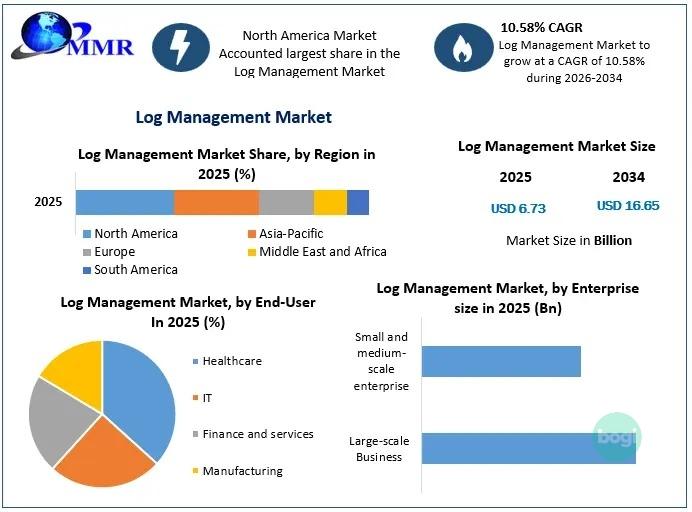
    According to Maximize Market Research, the Log Management Market size was valued at USD 6.73 Billion in 2025 and is expected to grow at a CAGR of 10.58% from 2026 to 2034, reaching nearly USD 16.65 Billion by 2034.

    Log Management Market Estimation, Growth Drivers & Opportunities

    The increasing frequency of cyberattacks, ransomware incidents, data breaches, and unauthorized network access is creating substantial demand for advanced log management platforms. Organizations across banking, healthcare, manufacturing, telecommunications, and IT industries are adopting centralized logging solutions to monitor system activities, identify suspicious behavior, and strengthen their security infrastructure.

    The growing adoption of cloud-based applications, Internet of Things (IoT) devices, and distributed IT environments is another significant growth driver. These technologies generate enormous volumes of machine data, increasing the requirement for automated log collection, analysis, and storage.

    Furthermore, AI-powered log analytics offers opportunities for vendors to introduce intelligent monitoring, predictive maintenance, automated incident detection, and faster troubleshooting capabilities. Increasing investments in cloud infrastructure and digital transformation, particularly among small and medium-sized enterprises, are expected to create additional opportunities throughout the forecast period.

    Receive a Free Sample Copy Instantly : https://www.maximizemarketresearch.com/request-sample/22019/

    Log Management Market Demand Analysis and Emerging Technology Opportunities Report by MMR Log Management Market to Reach USD 16.65 Billion by 2034, Driven by Rising Cybersecurity Threats and AI Integration The Log Management Market is witnessing significant growth as organizations increasingly prioritize cybersecurity, real-time threat detection, regulatory compliance, and efficient IT infrastructure management. Log management solutions help businesses collect, monitor, analyze, and store log data generated by applications, servers, networks, and cloud environments. The growing adoption of artificial intelligence (AI), machine learning (ML), cloud computing, and advanced security analytics is further strengthening market demand. According to Maximize Market Research, the Log Management Market size was valued at USD 6.73 Billion in 2025 and is expected to grow at a CAGR of 10.58% from 2026 to 2034, reaching nearly USD 16.65 Billion by 2034. Log Management Market Estimation, Growth Drivers & Opportunities The increasing frequency of cyberattacks, ransomware incidents, data breaches, and unauthorized network access is creating substantial demand for advanced log management platforms. Organizations across banking, healthcare, manufacturing, telecommunications, and IT industries are adopting centralized logging solutions to monitor system activities, identify suspicious behavior, and strengthen their security infrastructure. The growing adoption of cloud-based applications, Internet of Things (IoT) devices, and distributed IT environments is another significant growth driver. These technologies generate enormous volumes of machine data, increasing the requirement for automated log collection, analysis, and storage. Furthermore, AI-powered log analytics offers opportunities for vendors to introduce intelligent monitoring, predictive maintenance, automated incident detection, and faster troubleshooting capabilities. Increasing investments in cloud infrastructure and digital transformation, particularly among small and medium-sized enterprises, are expected to create additional opportunities throughout the forecast period. Receive a Free Sample Copy Instantly : https://www.maximizemarketresearch.com/request-sample/22019/
    0 Reacties 0 aandelen 528 Views
  • 5G Market in Aviation Growth Outlook and Rising Connectivity Demand Report by MMR

    5G Market in Aviation Set to Reach US$ 115.92 Billion by 2034, Driven by Smart Airport Development and Advanced Connectivity

    Market Estimation, Growth Drivers and Opportunities

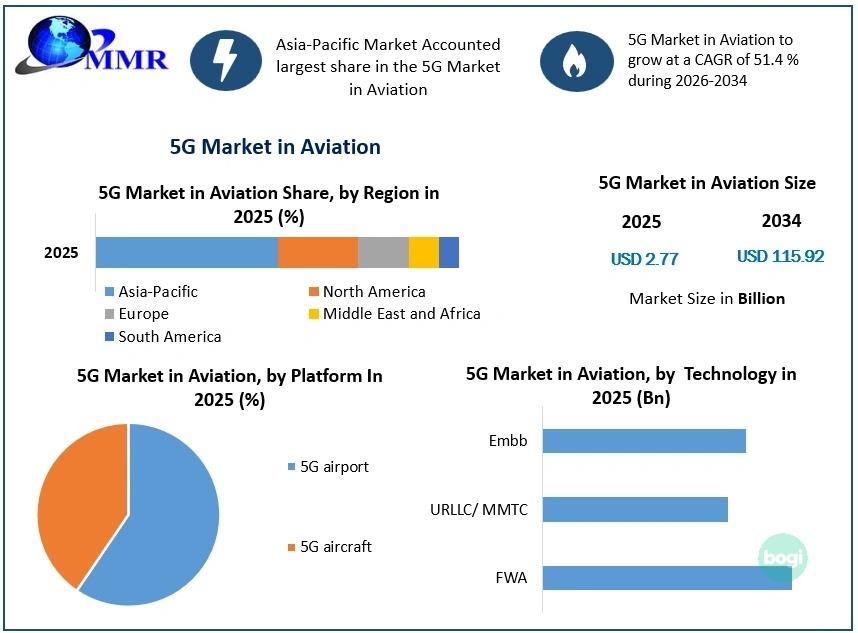
    The 5G Market in Aviation is witnessing remarkable growth as airlines, airports, and aviation technology providers increasingly adopt advanced wireless communication infrastructure. According to Maximize Market Research, the market was valued at US$ 2.77 billion in 2025 and is projected to reach US$ 115.92 billion by 2034, registering a CAGR of 51.4% during the forecast period. The increasing demand for high-speed connectivity, real-time communication, automated airport operations, and connected aircraft is creating significant opportunities for market participants.

    The growing adoption of the Internet of Things (IoT), artificial intelligence (AI), cloud computing, and data-driven aviation operations is supporting market expansion. 5G technology enables faster data transmission, lower latency, and improved network reliability compared with previous wireless generations. These capabilities are essential for applications such as intelligent baggage handling, predictive aircraft maintenance, real-time flight monitoring, passenger information systems, and advanced in-flight entertainment. Furthermore, increasing passenger traffic and investments in smart airport infrastructure are encouraging aviation operators to upgrade their existing communication networks. The expansion of unmanned aerial vehicles (UAVs), autonomous ground vehicles, and advanced air mobility services is also creating new opportunities for 5G infrastructure providers.

    US Market Trends and Investments

    The United States is emerging as an important innovation centre for 5G adoption in aviation, supported by investments in private wireless networks, aircraft connectivity, and smart airport infrastructure. In 2025, NASA conducted research and flight testing to evaluate how 5G-based communication networks could support future air taxi operations and advanced air mobility. The research explored the potential of cellular technology for reliable communication between aircraft and ground infrastructure. Additionally, Gogo advanced its next-generation 5G Air-to-Ground (ATG) connectivity programme through successful technology testing and collaboration with Airspan Networks and GCT Semiconductor. Ericsson also highlighted private 5G applications for airport infrastructure, including computer vision, connected devices, and automated baggage operations. These developments demonstrate increasing investment in aviation connectivity and the development of advanced wireless solutions across the American aviation industry.

    Get Your Free Sample Report Link : https://www.maximizemarketresearch.com/request-sample/106910/

    5G Market in Aviation Growth Outlook and Rising Connectivity Demand Report by MMR 5G Market in Aviation Set to Reach US$ 115.92 Billion by 2034, Driven by Smart Airport Development and Advanced Connectivity Market Estimation, Growth Drivers and Opportunities The 5G Market in Aviation is witnessing remarkable growth as airlines, airports, and aviation technology providers increasingly adopt advanced wireless communication infrastructure. According to Maximize Market Research, the market was valued at US$ 2.77 billion in 2025 and is projected to reach US$ 115.92 billion by 2034, registering a CAGR of 51.4% during the forecast period. The increasing demand for high-speed connectivity, real-time communication, automated airport operations, and connected aircraft is creating significant opportunities for market participants. The growing adoption of the Internet of Things (IoT), artificial intelligence (AI), cloud computing, and data-driven aviation operations is supporting market expansion. 5G technology enables faster data transmission, lower latency, and improved network reliability compared with previous wireless generations. These capabilities are essential for applications such as intelligent baggage handling, predictive aircraft maintenance, real-time flight monitoring, passenger information systems, and advanced in-flight entertainment. Furthermore, increasing passenger traffic and investments in smart airport infrastructure are encouraging aviation operators to upgrade their existing communication networks. The expansion of unmanned aerial vehicles (UAVs), autonomous ground vehicles, and advanced air mobility services is also creating new opportunities for 5G infrastructure providers. US Market Trends and Investments The United States is emerging as an important innovation centre for 5G adoption in aviation, supported by investments in private wireless networks, aircraft connectivity, and smart airport infrastructure. In 2025, NASA conducted research and flight testing to evaluate how 5G-based communication networks could support future air taxi operations and advanced air mobility. The research explored the potential of cellular technology for reliable communication between aircraft and ground infrastructure. Additionally, Gogo advanced its next-generation 5G Air-to-Ground (ATG) connectivity programme through successful technology testing and collaboration with Airspan Networks and GCT Semiconductor. Ericsson also highlighted private 5G applications for airport infrastructure, including computer vision, connected devices, and automated baggage operations. These developments demonstrate increasing investment in aviation connectivity and the development of advanced wireless solutions across the American aviation industry. Get Your Free Sample Report Link : https://www.maximizemarketresearch.com/request-sample/106910/
    0 Reacties 0 aandelen 570 Views