



Flexographic Ink Market Size, Trends, Demand, and Revenue Forecast
Key Highlights
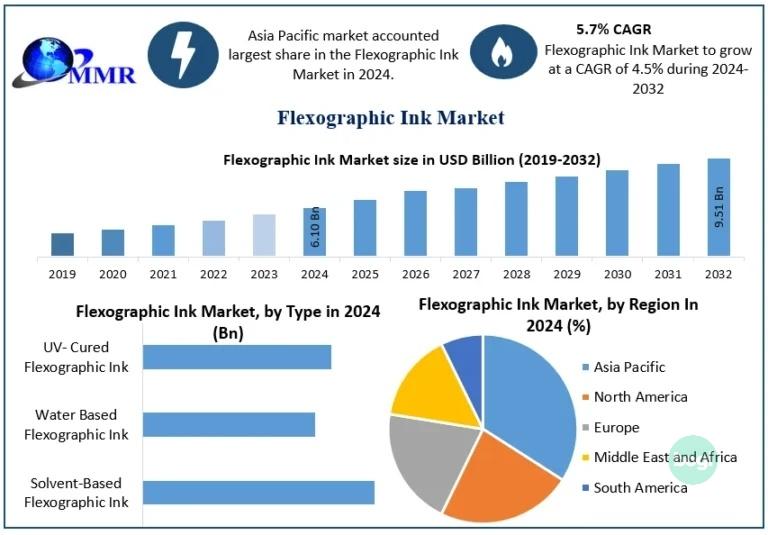
The Flexographic Ink Market was valued at US$ 6.10 Bn. in 2024, establishing a substantial revenue base for ink manufacturers and suppliers.
The market is expected to reach US$ 9.51 Bn. by 2032 at a 5.7% CAGR, signaling sustained commercial expansion.
Water-based flexographic ink represented more than 50% of global volume in 2024, highlighting strong demand for lower-emission printing solutions.
Flexible packaging is projected to grow at more than 4.5% CAGR, creating additional opportunities for ink producers.
Asia Pacific recorded the highest market share in 2024, while Europe remains a major regional market.
Market Overview
The Flexographic Ink Market is entering a period where performance and environmental considerations increasingly influence purchasing decisions. The market reached US$ 6.10 Bn. in 2024, demonstrating the scale of demand across packaging and printing applications.
The projected value of US$ 9.51 Bn. by 2032 indicates an expanding opportunity for manufacturers that can align product performance with changing packaging requirements. Growth is supported by the broader printing industry and demand for cost-effective, environment-friendly ink offerings.
Why This Market Matters Now
Packaging producers need printing solutions that balance quality, operational efficiency, and environmental considerations. Water-based formulations are gaining attention because they offer lower VOC emissions, reduced flammability, and stable viscosity during printing.
For procurement teams, this shift creates opportunities to reassess ink portfolios around application requirements. For manufacturers, it increases the importance of formulation innovation and product differentiation as packaging markets continue to develop.
Access a Free Sample Report Copy : https://www.maximizemarketresearch.com/request-sample/31279/
Key Trends Driving Growth
A major trend in the Flexographic Ink Market is the movement toward water-based technologies. In 2024, this segment accounted for more than 50% of global market volume, showing its growing commercial relevance across paper, corrugated cardboard, textiles, foils, plastics, and food packaging.
Key Highlights
The Flexographic Ink Market was valued at US$ 6.10 Bn. in 2024, establishing a substantial revenue base for ink manufacturers and suppliers.
The market is expected to reach US$ 9.51 Bn. by 2032 at a 5.7% CAGR, signaling sustained commercial expansion.
Water-based flexographic ink represented more than 50% of global volume in 2024, highlighting strong demand for lower-emission printing solutions.
Flexible packaging is projected to grow at more than 4.5% CAGR, creating additional opportunities for ink producers.
Asia Pacific recorded the highest market share in 2024, while Europe remains a major regional market.
Market Overview
The Flexographic Ink Market is entering a period where performance and environmental considerations increasingly influence purchasing decisions. The market reached US$ 6.10 Bn. in 2024, demonstrating the scale of demand across packaging and printing applications.
The projected value of US$ 9.51 Bn. by 2032 indicates an expanding opportunity for manufacturers that can align product performance with changing packaging requirements. Growth is supported by the broader printing industry and demand for cost-effective, environment-friendly ink offerings.
Why This Market Matters Now
Packaging producers need printing solutions that balance quality, operational efficiency, and environmental considerations. Water-based formulations are gaining attention because they offer lower VOC emissions, reduced flammability, and stable viscosity during printing.
For procurement teams, this shift creates opportunities to reassess ink portfolios around application requirements. For manufacturers, it increases the importance of formulation innovation and product differentiation as packaging markets continue to develop.
Access a Free Sample Report Copy : https://www.maximizemarketresearch.com/request-sample/31279/
Key Trends Driving Growth
A major trend in the Flexographic Ink Market is the movement toward water-based technologies. In 2024, this segment accounted for more than 50% of global market volume, showing its growing commercial relevance across paper, corrugated cardboard, textiles, foils, plastics, and food packaging.
Flexographic Ink Market Size, Trends, Demand, and Revenue Forecast
Key Highlights
The Flexographic Ink Market was valued at US$ 6.10 Bn. in 2024, establishing a substantial revenue base for ink manufacturers and suppliers.
The market is expected to reach US$ 9.51 Bn. by 2032 at a 5.7% CAGR, signaling sustained commercial expansion.
Water-based flexographic ink represented more than 50% of global volume in 2024, highlighting strong demand for lower-emission printing solutions.
Flexible packaging is projected to grow at more than 4.5% CAGR, creating additional opportunities for ink producers.
Asia Pacific recorded the highest market share in 2024, while Europe remains a major regional market.
Market Overview
The Flexographic Ink Market is entering a period where performance and environmental considerations increasingly influence purchasing decisions. The market reached US$ 6.10 Bn. in 2024, demonstrating the scale of demand across packaging and printing applications.
The projected value of US$ 9.51 Bn. by 2032 indicates an expanding opportunity for manufacturers that can align product performance with changing packaging requirements. Growth is supported by the broader printing industry and demand for cost-effective, environment-friendly ink offerings.
Why This Market Matters Now
Packaging producers need printing solutions that balance quality, operational efficiency, and environmental considerations. Water-based formulations are gaining attention because they offer lower VOC emissions, reduced flammability, and stable viscosity during printing.
For procurement teams, this shift creates opportunities to reassess ink portfolios around application requirements. For manufacturers, it increases the importance of formulation innovation and product differentiation as packaging markets continue to develop.
Access a Free Sample Report Copy : https://www.maximizemarketresearch.com/request-sample/31279/
Key Trends Driving Growth
A major trend in the Flexographic Ink Market is the movement toward water-based technologies. In 2024, this segment accounted for more than 50% of global market volume, showing its growing commercial relevance across paper, corrugated cardboard, textiles, foils, plastics, and food packaging.
0 Comments
0 Shares
535 Views





 Arabic
 French
 Spanish
 Portuguese
 Deutsch
 Turkish
 Dutch
Dutch
 Italiano
 Russian
 Romaian
 Portuguese (Brazil)
 Greek
Greek