



Urea Market Recent Developments and Industry Outlook Report by MMR
Urea Market to Reach USD 56.72 Billion by 2032, Driven by Rising Agricultural Demand and Sustainable Fertilizer Production
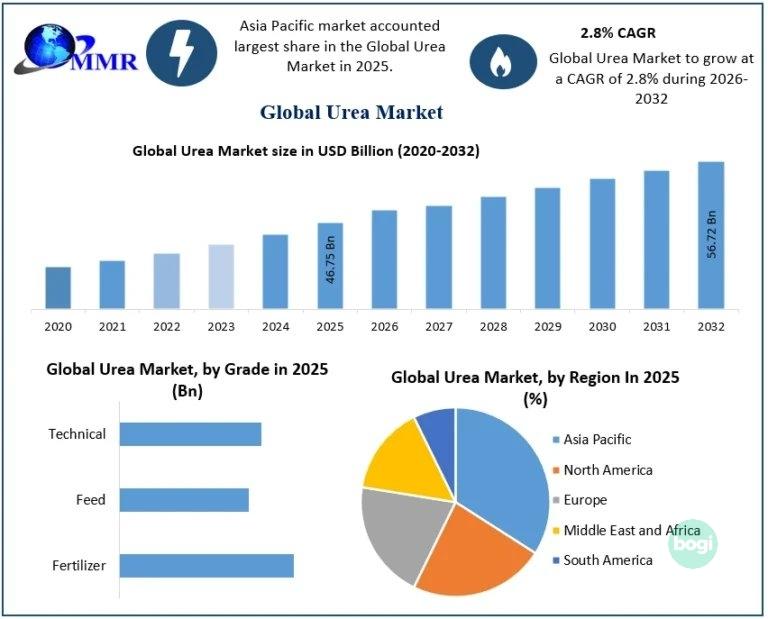
The Urea Market was valued at USD 46.75 billion in 2025 and is projected to reach nearly USD 56.72 billion by 2032, growing at a compound annual growth rate (CAGR) of 2.8% during the forecast period from 2026 to 2032. According to Maximize Market Research, increasing demand for nitrogen-based fertilizers, growing agricultural productivity requirements, expanding industrial applications, and advancements in sustainable fertilizer manufacturing are expected to support market expansion. Urea remains an essential agricultural input because of its high nitrogen content, affordability, and effectiveness in supporting crop growth. Additionally, increasing applications in chemical manufacturing, industrial resins, and automotive emission-control technologies are creating opportunities for manufacturers worldwide.
Urea Market Estimation, Growth Drivers, and Opportunities
The Urea Market is experiencing steady growth as agricultural producers seek to improve crop yields and meet rising global food requirements. With a nitrogen content of approximately 46%, urea is widely used to support the growth of cereals, grains, vegetables, fruits, and other agricultural crops. Population growth, limited arable land, and the increasing need for food security are encouraging farmers to adopt effective fertilizer solutions.
Government fertilizer subsidies, agricultural modernization programs, and precision farming practices are further supporting demand. Developing economies continue to offer substantial opportunities because of their large agricultural sectors and growing fertilizer consumption.
Industrial applications are also creating new growth opportunities. Urea is used in urea-formaldehyde resins, adhesives, plastics, and diesel exhaust fluid (DEF), which helps reduce nitrogen oxide emissions from diesel-powered vehicles. Manufacturers investing in energy-efficient production, enhanced-efficiency fertilizers, carbon capture, and low-carbon ammonia technologies can strengthen their competitiveness. However, natural gas price fluctuations, environmental concerns, and international supply-chain disruptions remain important challenges for the industry.
Request Your Sample Market Report PDF : https://www.maximizemarketresearch.com/request-sample/26788/
Urea Market Recent Developments and Industry Outlook Report by MMR
Urea Market to Reach USD 56.72 Billion by 2032, Driven by Rising Agricultural Demand and Sustainable Fertilizer Production
The Urea Market was valued at USD 46.75 billion in 2025 and is projected to reach nearly USD 56.72 billion by 2032, growing at a compound annual growth rate (CAGR) of 2.8% during the forecast period from 2026 to 2032. According to Maximize Market Research, increasing demand for nitrogen-based fertilizers, growing agricultural productivity requirements, expanding industrial applications, and advancements in sustainable fertilizer manufacturing are expected to support market expansion. Urea remains an essential agricultural input because of its high nitrogen content, affordability, and effectiveness in supporting crop growth. Additionally, increasing applications in chemical manufacturing, industrial resins, and automotive emission-control technologies are creating opportunities for manufacturers worldwide.
Urea Market Estimation, Growth Drivers, and Opportunities
The Urea Market is experiencing steady growth as agricultural producers seek to improve crop yields and meet rising global food requirements. With a nitrogen content of approximately 46%, urea is widely used to support the growth of cereals, grains, vegetables, fruits, and other agricultural crops. Population growth, limited arable land, and the increasing need for food security are encouraging farmers to adopt effective fertilizer solutions.
Government fertilizer subsidies, agricultural modernization programs, and precision farming practices are further supporting demand. Developing economies continue to offer substantial opportunities because of their large agricultural sectors and growing fertilizer consumption.
Industrial applications are also creating new growth opportunities. Urea is used in urea-formaldehyde resins, adhesives, plastics, and diesel exhaust fluid (DEF), which helps reduce nitrogen oxide emissions from diesel-powered vehicles. Manufacturers investing in energy-efficient production, enhanced-efficiency fertilizers, carbon capture, and low-carbon ammonia technologies can strengthen their competitiveness. However, natural gas price fluctuations, environmental concerns, and international supply-chain disruptions remain important challenges for the industry.
Request Your Sample Market Report PDF : https://www.maximizemarketresearch.com/request-sample/26788/
0 Commentaires
0 Parts
123 Vue







 English
 Arabic
 Spanish
 Portuguese
 Deutsch
 Turkish
 Dutch
 Italiano
 Russian
 Romaian
 Portuguese (Brazil)
 Greek