



Gaming Software Market Emerging Trends and Projected Industry Growth
Key Highlights
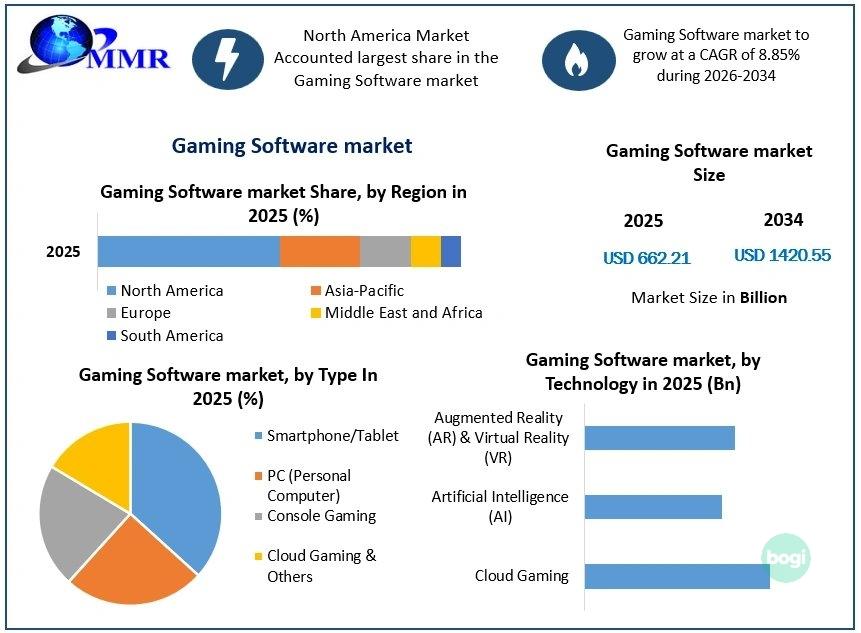
Market valued at USD 662.21 billion in 2025.
Revenue is projected to reach nearly USD 1,420.55 billion by 2034.
CAGR of 8.85% is expected from 2026 to 2034.
Smartphone and tablet gaming dominated by type in 2025.
North America held the largest regional share in 2025.
Cloud gaming, AI, AR, and VR are reshaping software development.
Market Overview
The Gaming Software Market covers applications and programs used across smartphones, tablets, PCs, consoles, and online platforms. These technologies support game creation through engines, development tools, graphics capabilities, multiplayer services, and distribution platforms. The market’s scale reflects the growing importance of software as the foundation for modern gaming experiences.
The market was valued at USD 662.21 billion in 2025, establishing a substantial revenue base for developers, publishers, technology providers, and platform operators. Its projected expansion indicates that companies capable of combining accessibility, performance, and immersive experiences can capture increasing demand.
Why This Market Matters Now
Gaming is no longer restricted to high-end consoles or desktop computers. Smartphones and increasingly affordable mobile data have expanded access across age groups and demographics, strengthening demand for software optimized for different devices and operating systems.
At the same time, esports and game streaming are broadening gaming’s audience. More than 380 million people watch esports worldwide, increasing the commercial value of software capable of supporting competitive play, live interaction, and spectator-focused features.
Get a Free Sample Market Report Link : https://www.maximizemarketresearch.com/request-sample/213750/
Key Trends Driving Growth
Cloud gaming is changing the relationship between software and hardware. Instead of requiring users to install games locally, cloud-based services can stream content through applications or web browsers. This can widen access by reducing dependence on expensive gaming hardware.
Key Highlights
Market valued at USD 662.21 billion in 2025.
Revenue is projected to reach nearly USD 1,420.55 billion by 2034.
CAGR of 8.85% is expected from 2026 to 2034.
Smartphone and tablet gaming dominated by type in 2025.
North America held the largest regional share in 2025.
Cloud gaming, AI, AR, and VR are reshaping software development.
Market Overview
The Gaming Software Market covers applications and programs used across smartphones, tablets, PCs, consoles, and online platforms. These technologies support game creation through engines, development tools, graphics capabilities, multiplayer services, and distribution platforms. The market’s scale reflects the growing importance of software as the foundation for modern gaming experiences.
The market was valued at USD 662.21 billion in 2025, establishing a substantial revenue base for developers, publishers, technology providers, and platform operators. Its projected expansion indicates that companies capable of combining accessibility, performance, and immersive experiences can capture increasing demand.
Why This Market Matters Now
Gaming is no longer restricted to high-end consoles or desktop computers. Smartphones and increasingly affordable mobile data have expanded access across age groups and demographics, strengthening demand for software optimized for different devices and operating systems.
At the same time, esports and game streaming are broadening gaming’s audience. More than 380 million people watch esports worldwide, increasing the commercial value of software capable of supporting competitive play, live interaction, and spectator-focused features.
Get a Free Sample Market Report Link : https://www.maximizemarketresearch.com/request-sample/213750/
Key Trends Driving Growth
Cloud gaming is changing the relationship between software and hardware. Instead of requiring users to install games locally, cloud-based services can stream content through applications or web browsers. This can widen access by reducing dependence on expensive gaming hardware.
Gaming Software Market Emerging Trends and Projected Industry Growth
Key Highlights
Market valued at USD 662.21 billion in 2025.
Revenue is projected to reach nearly USD 1,420.55 billion by 2034.
CAGR of 8.85% is expected from 2026 to 2034.
Smartphone and tablet gaming dominated by type in 2025.
North America held the largest regional share in 2025.
Cloud gaming, AI, AR, and VR are reshaping software development.
Market Overview
The Gaming Software Market covers applications and programs used across smartphones, tablets, PCs, consoles, and online platforms. These technologies support game creation through engines, development tools, graphics capabilities, multiplayer services, and distribution platforms. The market’s scale reflects the growing importance of software as the foundation for modern gaming experiences.
The market was valued at USD 662.21 billion in 2025, establishing a substantial revenue base for developers, publishers, technology providers, and platform operators. Its projected expansion indicates that companies capable of combining accessibility, performance, and immersive experiences can capture increasing demand.
Why This Market Matters Now
Gaming is no longer restricted to high-end consoles or desktop computers. Smartphones and increasingly affordable mobile data have expanded access across age groups and demographics, strengthening demand for software optimized for different devices and operating systems.
At the same time, esports and game streaming are broadening gaming’s audience. More than 380 million people watch esports worldwide, increasing the commercial value of software capable of supporting competitive play, live interaction, and spectator-focused features.
Get a Free Sample Market Report Link : https://www.maximizemarketresearch.com/request-sample/213750/
Key Trends Driving Growth
Cloud gaming is changing the relationship between software and hardware. Instead of requiring users to install games locally, cloud-based services can stream content through applications or web browsers. This can widen access by reducing dependence on expensive gaming hardware.
0 التعليقات
0 المشاركات
471 مشاهدة

 English
 French
 Spanish
 Portuguese
 Deutsch
 Turkish
 Dutch
Dutch
 Italiano
 Russian
 Romaian
 Portuguese (Brazil)
 Greek
Greek