


5G Market in Aviation Growth Outlook and Rising Connectivity Demand Report by MMR
5G Market in Aviation Set to Reach US$ 115.92 Billion by 2034, Driven by Smart Airport Development and Advanced Connectivity
Market Estimation, Growth Drivers and Opportunities
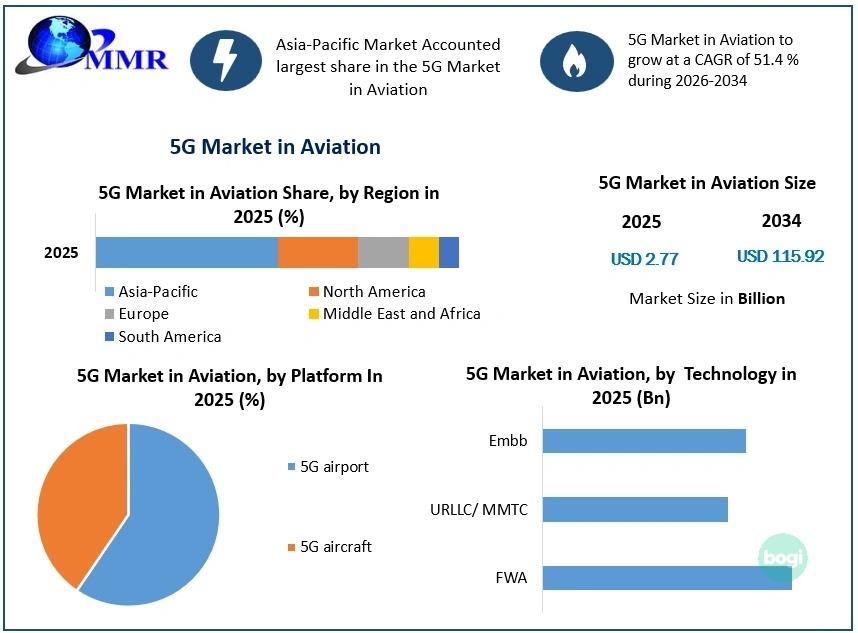
The 5G Market in Aviation is witnessing remarkable growth as airlines, airports, and aviation technology providers increasingly adopt advanced wireless communication infrastructure. According to Maximize Market Research, the market was valued at US$ 2.77 billion in 2025 and is projected to reach US$ 115.92 billion by 2034, registering a CAGR of 51.4% during the forecast period. The increasing demand for high-speed connectivity, real-time communication, automated airport operations, and connected aircraft is creating significant opportunities for market participants.
The growing adoption of the Internet of Things (IoT), artificial intelligence (AI), cloud computing, and data-driven aviation operations is supporting market expansion. 5G technology enables faster data transmission, lower latency, and improved network reliability compared with previous wireless generations. These capabilities are essential for applications such as intelligent baggage handling, predictive aircraft maintenance, real-time flight monitoring, passenger information systems, and advanced in-flight entertainment. Furthermore, increasing passenger traffic and investments in smart airport infrastructure are encouraging aviation operators to upgrade their existing communication networks. The expansion of unmanned aerial vehicles (UAVs), autonomous ground vehicles, and advanced air mobility services is also creating new opportunities for 5G infrastructure providers.
US Market Trends and Investments
The United States is emerging as an important innovation centre for 5G adoption in aviation, supported by investments in private wireless networks, aircraft connectivity, and smart airport infrastructure. In 2025, NASA conducted research and flight testing to evaluate how 5G-based communication networks could support future air taxi operations and advanced air mobility. The research explored the potential of cellular technology for reliable communication between aircraft and ground infrastructure. Additionally, Gogo advanced its next-generation 5G Air-to-Ground (ATG) connectivity programme through successful technology testing and collaboration with Airspan Networks and GCT Semiconductor. Ericsson also highlighted private 5G applications for airport infrastructure, including computer vision, connected devices, and automated baggage operations. These developments demonstrate increasing investment in aviation connectivity and the development of advanced wireless solutions across the American aviation industry.
Get Your Free Sample Report Link : https://www.maximizemarketresearch.com/request-sample/106910/
5G Market in Aviation Growth Outlook and Rising Connectivity Demand Report by MMR
5G Market in Aviation Set to Reach US$ 115.92 Billion by 2034, Driven by Smart Airport Development and Advanced Connectivity
Market Estimation, Growth Drivers and Opportunities
The 5G Market in Aviation is witnessing remarkable growth as airlines, airports, and aviation technology providers increasingly adopt advanced wireless communication infrastructure. According to Maximize Market Research, the market was valued at US$ 2.77 billion in 2025 and is projected to reach US$ 115.92 billion by 2034, registering a CAGR of 51.4% during the forecast period. The increasing demand for high-speed connectivity, real-time communication, automated airport operations, and connected aircraft is creating significant opportunities for market participants.
The growing adoption of the Internet of Things (IoT), artificial intelligence (AI), cloud computing, and data-driven aviation operations is supporting market expansion. 5G technology enables faster data transmission, lower latency, and improved network reliability compared with previous wireless generations. These capabilities are essential for applications such as intelligent baggage handling, predictive aircraft maintenance, real-time flight monitoring, passenger information systems, and advanced in-flight entertainment. Furthermore, increasing passenger traffic and investments in smart airport infrastructure are encouraging aviation operators to upgrade their existing communication networks. The expansion of unmanned aerial vehicles (UAVs), autonomous ground vehicles, and advanced air mobility services is also creating new opportunities for 5G infrastructure providers.
US Market Trends and Investments
The United States is emerging as an important innovation centre for 5G adoption in aviation, supported by investments in private wireless networks, aircraft connectivity, and smart airport infrastructure. In 2025, NASA conducted research and flight testing to evaluate how 5G-based communication networks could support future air taxi operations and advanced air mobility. The research explored the potential of cellular technology for reliable communication between aircraft and ground infrastructure. Additionally, Gogo advanced its next-generation 5G Air-to-Ground (ATG) connectivity programme through successful technology testing and collaboration with Airspan Networks and GCT Semiconductor. Ericsson also highlighted private 5G applications for airport infrastructure, including computer vision, connected devices, and automated baggage operations. These developments demonstrate increasing investment in aviation connectivity and the development of advanced wireless solutions across the American aviation industry.
Get Your Free Sample Report Link : https://www.maximizemarketresearch.com/request-sample/106910/
0 Commenti
0 condivisioni
458 Views

 English
 Arabic
 French
 Spanish
 Portuguese
 Deutsch
 Turkish
 Dutch
 Russian
 Romaian
 Portuguese (Brazil)
 Greek