


Wireless In-Flight Entertainment Market Key Growth Drivers and Industry Challenges Report by MMR
Wireless In-Flight Entertainment Market to Reach USD 6.74 Billion by 2030, Driven by High-Speed Connectivity and Personalized Passenger Experiences
Market Estimation, Growth Drivers, and Opportunities
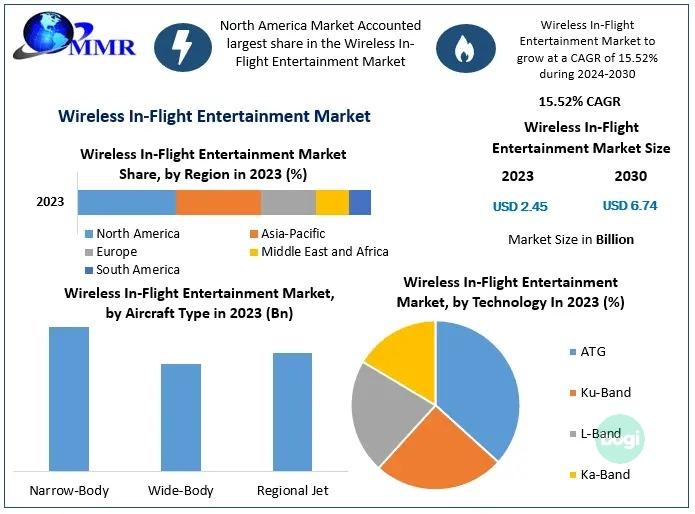
The Wireless In-Flight Entertainment Market was valued at USD 2.45 billion in 2023 and is projected to reach approximately USD 6.74 billion by 2030, growing at a compound annual growth rate (CAGR) of 15.52% during the forecast period from 2024 to 2030. The market is experiencing significant transformation as airlines increasingly adopt wireless technologies to deliver convenient, personalized, and cost-effective entertainment services to passengers.
Wireless in-flight entertainment systems enable passengers to access movies, television programs, music, games, and other digital services through personal smartphones, tablets, and laptops using onboard wireless networks. Unlike traditional seatback entertainment systems, wireless solutions can reduce aircraft weight, simplify installation, and lower maintenance expenses. These advantages are encouraging airlines to modernize existing fleets while improving the overall passenger experience.
Increasing air passenger traffic, growing smartphone penetration, and rising expectations for seamless digital connectivity are major growth drivers. Passengers increasingly expect entertainment options similar to those available at home, including personalized content libraries and convenient streaming experiences. Airlines are responding by investing in wireless access points, advanced modems, satellite connectivity, and integrated onboard digital platforms.
Significant opportunities exist in aircraft retrofitting, cloud-based content management, targeted advertising, and partnerships between airlines, connectivity providers, and entertainment platforms. However, high installation costs, cybersecurity concerns, bandwidth limitations, and regulatory requirements remain important challenges. Companies capable of delivering secure, scalable, and reliable connectivity solutions are well positioned to benefit from the market's expansion.
Get Your Free Sample Report Link : https://www.maximizemarketresearch.com/request-sample/19884/
Wireless In-Flight Entertainment Market Key Growth Drivers and Industry Challenges Report by MMR
Wireless In-Flight Entertainment Market to Reach USD 6.74 Billion by 2030, Driven by High-Speed Connectivity and Personalized Passenger Experiences
Market Estimation, Growth Drivers, and Opportunities
The Wireless In-Flight Entertainment Market was valued at USD 2.45 billion in 2023 and is projected to reach approximately USD 6.74 billion by 2030, growing at a compound annual growth rate (CAGR) of 15.52% during the forecast period from 2024 to 2030. The market is experiencing significant transformation as airlines increasingly adopt wireless technologies to deliver convenient, personalized, and cost-effective entertainment services to passengers.
Wireless in-flight entertainment systems enable passengers to access movies, television programs, music, games, and other digital services through personal smartphones, tablets, and laptops using onboard wireless networks. Unlike traditional seatback entertainment systems, wireless solutions can reduce aircraft weight, simplify installation, and lower maintenance expenses. These advantages are encouraging airlines to modernize existing fleets while improving the overall passenger experience.
Increasing air passenger traffic, growing smartphone penetration, and rising expectations for seamless digital connectivity are major growth drivers. Passengers increasingly expect entertainment options similar to those available at home, including personalized content libraries and convenient streaming experiences. Airlines are responding by investing in wireless access points, advanced modems, satellite connectivity, and integrated onboard digital platforms.
Significant opportunities exist in aircraft retrofitting, cloud-based content management, targeted advertising, and partnerships between airlines, connectivity providers, and entertainment platforms. However, high installation costs, cybersecurity concerns, bandwidth limitations, and regulatory requirements remain important challenges. Companies capable of delivering secure, scalable, and reliable connectivity solutions are well positioned to benefit from the market's expansion.
Get Your Free Sample Report Link : https://www.maximizemarketresearch.com/request-sample/19884/
0 Comments
0 Shares
12 Views

 Arabic
 French
 Spanish
 Portuguese
 Deutsch
 Turkish
 Dutch
 Italiano
 Russian
 Romaian
 Portuguese (Brazil)
 Greek