


Fluorophore Market Size Analysis, Key Insights, and Revenue Opportunities
Fluorophore Market to Reach USD 2,917.55 Million by 2032, Driven by Advances in Biomedical Research
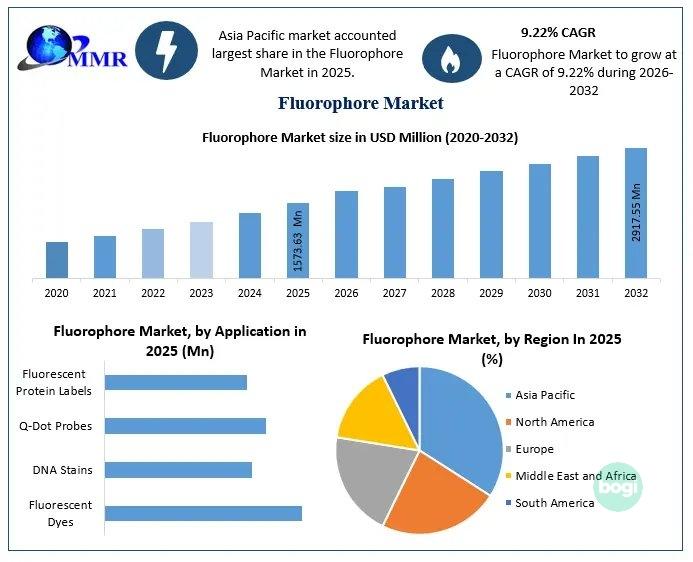
The Fluorophore Market is witnessing substantial growth as demand for advanced fluorescence imaging, molecular diagnostics, biotechnology research, and pharmaceutical development continues to increase. According to Maximize Market Research, the market was valued at USD 1,573.63 million in 2025 and is projected to reach nearly USD 2,917.55 million by 2032, expanding at a compound annual growth rate (CAGR) of 9.22% from 2026 to 2032. Increasing investment in life sciences, improvements in fluorescent labeling technologies, and the growing need for precise cellular analysis are expected to create significant opportunities for industry participants.
Fluorophore Market Estimation, Growth Drivers, and Opportunities
Fluorophores are fluorescent compounds that absorb light at specific wavelengths and emit light at different wavelengths, enabling researchers to identify, label, and monitor biological structures and chemical processes. These compounds are widely used in fluorescence microscopy, flow cytometry, DNA analysis, immunoassays, drug discovery, and clinical diagnostics.
The market's growth is supported by the increasing prevalence of research-intensive diseases, rising demand for molecular-level investigations, and expanding applications of fluorescence-based technologies in biotechnology and pharmaceutical laboratories. Researchers increasingly rely on fluorophores to examine cellular behavior, detect biomarkers, evaluate drug responses, and study interactions between biological molecules.
Technological improvements in dye brightness, photostability, spectral separation, and labeling efficiency are further strengthening market demand. Advanced fluorophores can support multicolor experiments, improve signal detection, and enable more detailed analysis of complex biological samples.
Emerging opportunities include the development of near-infrared fluorophores, specialized probes for live-cell imaging, improved fluorescent protein labels, and environmentally conscious labeling materials. Growing interest in personalized medicine, high-throughput screening, precision diagnostics, and advanced microscopy is also expected to support revenue growth. However, high research and development costs, complex manufacturing processes, and the need for consistent product performance remain important industry challenges.
Get Your Free Sample Report Link : https://www.maximizemarketresearch.com/request-sample/81119/
Fluorophore Market Size Analysis, Key Insights, and Revenue Opportunities
Fluorophore Market to Reach USD 2,917.55 Million by 2032, Driven by Advances in Biomedical Research
The Fluorophore Market is witnessing substantial growth as demand for advanced fluorescence imaging, molecular diagnostics, biotechnology research, and pharmaceutical development continues to increase. According to Maximize Market Research, the market was valued at USD 1,573.63 million in 2025 and is projected to reach nearly USD 2,917.55 million by 2032, expanding at a compound annual growth rate (CAGR) of 9.22% from 2026 to 2032. Increasing investment in life sciences, improvements in fluorescent labeling technologies, and the growing need for precise cellular analysis are expected to create significant opportunities for industry participants.
Fluorophore Market Estimation, Growth Drivers, and Opportunities
Fluorophores are fluorescent compounds that absorb light at specific wavelengths and emit light at different wavelengths, enabling researchers to identify, label, and monitor biological structures and chemical processes. These compounds are widely used in fluorescence microscopy, flow cytometry, DNA analysis, immunoassays, drug discovery, and clinical diagnostics.
The market's growth is supported by the increasing prevalence of research-intensive diseases, rising demand for molecular-level investigations, and expanding applications of fluorescence-based technologies in biotechnology and pharmaceutical laboratories. Researchers increasingly rely on fluorophores to examine cellular behavior, detect biomarkers, evaluate drug responses, and study interactions between biological molecules.
Technological improvements in dye brightness, photostability, spectral separation, and labeling efficiency are further strengthening market demand. Advanced fluorophores can support multicolor experiments, improve signal detection, and enable more detailed analysis of complex biological samples.
Emerging opportunities include the development of near-infrared fluorophores, specialized probes for live-cell imaging, improved fluorescent protein labels, and environmentally conscious labeling materials. Growing interest in personalized medicine, high-throughput screening, precision diagnostics, and advanced microscopy is also expected to support revenue growth. However, high research and development costs, complex manufacturing processes, and the need for consistent product performance remain important industry challenges.
Get Your Free Sample Report Link : https://www.maximizemarketresearch.com/request-sample/81119/
0 Comments
0 Shares
429 Views

 Arabic
 French
 Spanish
 Portuguese
 Deutsch
 Turkish
 Dutch
 Italiano
 Russian
 Romaian
 Portuguese (Brazil)
 Greek