


Fuel Additives Market Competitive Analysis and Revenue Growth Forecast
Fuel Additives Market to Reach New Heights as Demand for Cleaner and More Efficient Fuels Accelerates
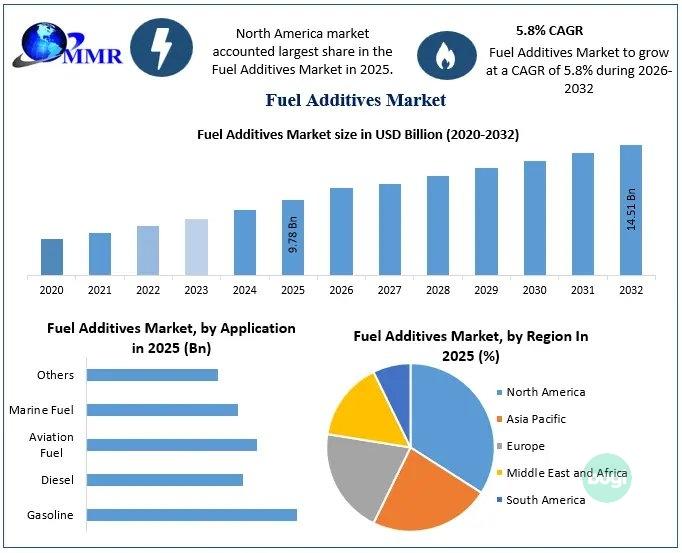
The Fuel Additives Market is witnessing steady growth as automotive manufacturers, fuel producers, transportation companies, and industrial operators increasingly focus on fuel efficiency, engine performance, emission reduction, and equipment durability. According to Maximize Market Research, the Fuel Additives Market was valued at USD 9.78 billion in 2025 and is projected to grow at a compound annual growth rate (CAGR) of 5.8% over the forecast period. Growing transportation demand, evolving fuel quality standards, technological advancements, and the need to optimize conventional fuel performance are supporting the market's expansion.
Market Estimation, Growth Drivers, and Opportunities
The global Fuel Additives Market is benefiting from the increasing need to improve fuel combustion, reduce engine deposits, prevent corrosion, enhance lubrication, and maintain fuel stability. Fuel additives are specialized chemical compounds blended into gasoline, diesel, aviation fuel, and other petroleum-based fuels to improve their performance and handling characteristics.
Several factors are driving market growth. Rising global vehicle ownership and freight transportation are increasing fuel consumption, while industrial machinery, construction equipment, marine transportation, and aviation continue to require reliable fuel solutions. Fuel additives help engines operate more efficiently, support injector cleanliness, reduce deposit formation, and improve performance under demanding operating conditions.
Environmental regulations and fuel quality requirements are also creating opportunities for advanced additive formulations. Detergents, antioxidants, cetane improvers, octane boosters, corrosion inhibitors, and cold-flow improvers are increasingly important for meeting specific engine and fuel performance requirements. Growing interest in renewable diesel, biodiesel blends, and sustainable aviation fuels presents additional opportunities for additive developers to improve oxidation stability, compatibility, and low-temperature performance.
However, fluctuating petrochemical feedstock prices, regulatory complexity, and the gradual transition toward electrification may create challenges. Manufacturers that invest in high-performance formulations, cleaner production methods, and fuel-compatible technologies are well positioned to capitalize on evolving demand.
Request a Sample of the Full Market Report : https://www.maximizemarketresearch.com/request-sample/32500/
US Market Trends and Investment Outlook
The United States remains an important market for fuel additives because of its extensive transportation network, substantial gasoline and diesel consumption, aviation activity, and established refining industry. Developments during 2025 continued to highlight the importance of fuel quality, refinery reliability, and lower-emission transportation solutions. Federal renewable fuel requirements under the Renewable Fuel Standard and continued implementation of vehicle emissions and fuel economy regulations have encouraged industry participants to evaluate compatible fuels and advanced additive technologies.
Fuel Additives Market Competitive Analysis and Revenue Growth Forecast
Fuel Additives Market to Reach New Heights as Demand for Cleaner and More Efficient Fuels Accelerates
The Fuel Additives Market is witnessing steady growth as automotive manufacturers, fuel producers, transportation companies, and industrial operators increasingly focus on fuel efficiency, engine performance, emission reduction, and equipment durability. According to Maximize Market Research, the Fuel Additives Market was valued at USD 9.78 billion in 2025 and is projected to grow at a compound annual growth rate (CAGR) of 5.8% over the forecast period. Growing transportation demand, evolving fuel quality standards, technological advancements, and the need to optimize conventional fuel performance are supporting the market's expansion.
Market Estimation, Growth Drivers, and Opportunities
The global Fuel Additives Market is benefiting from the increasing need to improve fuel combustion, reduce engine deposits, prevent corrosion, enhance lubrication, and maintain fuel stability. Fuel additives are specialized chemical compounds blended into gasoline, diesel, aviation fuel, and other petroleum-based fuels to improve their performance and handling characteristics.
Several factors are driving market growth. Rising global vehicle ownership and freight transportation are increasing fuel consumption, while industrial machinery, construction equipment, marine transportation, and aviation continue to require reliable fuel solutions. Fuel additives help engines operate more efficiently, support injector cleanliness, reduce deposit formation, and improve performance under demanding operating conditions.
Environmental regulations and fuel quality requirements are also creating opportunities for advanced additive formulations. Detergents, antioxidants, cetane improvers, octane boosters, corrosion inhibitors, and cold-flow improvers are increasingly important for meeting specific engine and fuel performance requirements. Growing interest in renewable diesel, biodiesel blends, and sustainable aviation fuels presents additional opportunities for additive developers to improve oxidation stability, compatibility, and low-temperature performance.
However, fluctuating petrochemical feedstock prices, regulatory complexity, and the gradual transition toward electrification may create challenges. Manufacturers that invest in high-performance formulations, cleaner production methods, and fuel-compatible technologies are well positioned to capitalize on evolving demand.
Request a Sample of the Full Market Report : https://www.maximizemarketresearch.com/request-sample/32500/
US Market Trends and Investment Outlook
The United States remains an important market for fuel additives because of its extensive transportation network, substantial gasoline and diesel consumption, aviation activity, and established refining industry. Developments during 2025 continued to highlight the importance of fuel quality, refinery reliability, and lower-emission transportation solutions. Federal renewable fuel requirements under the Renewable Fuel Standard and continued implementation of vehicle emissions and fuel economy regulations have encouraged industry participants to evaluate compatible fuels and advanced additive technologies.
0 Reacties
0 aandelen
581 Views

 English
 Arabic
 French
 Spanish
 Portuguese
 Deutsch
 Turkish
 Italiano
 Russian
 Romaian
 Portuguese (Brazil)
 Greek