


Air Pollution Control Systems Market Development Key Insights and Emerging Opportunities
Air Pollution Control Systems Market to Reach USD 131.36 Billion by 2034, Supported by Industrial Expansion and Stricter Emission Management
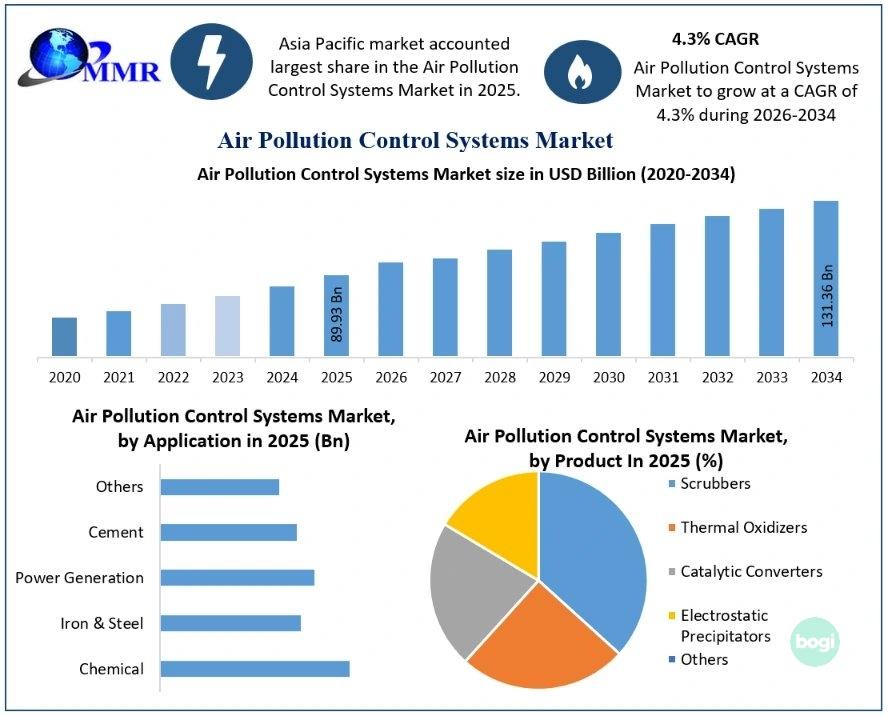
The Air Pollution Control Systems Market was valued at USD 89.93 billion in 2025 and is projected to reach USD 131.36 billion by 2034, expanding at a CAGR of 4.3% from 2026 to 2034. Rapid industrialization, urban populations, respiratory-health concerns, and demand for cleaner environments are shaping the market. Increasing investment in power generation, chemicals, iron and steel, cement, and other pollution-intensive industries is creating sustained demand for emission-control equipment. Manufacturers are focusing on energy-efficient systems, digital monitoring, advanced filtration, and technologies capable of controlling multiple pollutants. Opportunities are emerging from modernization and retrofit projects, particularly where aging plants must improve environmental performance without replacing entire production assets. Developing-economy industrial expansion and cleaner production requirements are creating opportunities for system suppliers and engineering companies.
U.S. Market Trends and Investment
The U.S. market is experiencing a complex transition in 2025 as electricity demand rises alongside changes in federal environmental policy. The U.S. Environmental Protection Agency proposed in June 2025 to repeal federal greenhouse-gas emissions standards for fossil-fuel power plants and amendments to the Mercury and Air Toxics Standards. While the proposals could reduce compliance costs and alter investment timing for some operators, the installed base of pollution-control equipment, state-level requirements, industrial modernization, and demand from data centers continue to support air-quality technologies. U.S. investment is increasingly focused on upgrades, maintenance, monitoring, efficiency improvements, and emissions-control retrofits. Suppliers offering flexible, cost-effective systems can benefit.
Market Segmentation: Largest Shares
By product, the Scrubbers segment held the dominant position in the global Air Pollution Control Systems Market in terms of revenue. Scrubbers remove particulate matter and gases using liquid-based treatment and are widely applied for contaminant control. By application, power generation is expected to witness the fastest growth through the forecast period, while iron and steel is the highest-growth application. By region, Asia Pacific held the highest market share and is projected to maintain its leadership, supported by industrial expansion and investment in power generation, chemicals, mining, and heavy industry.
Access a Free Sample Report Copy : https://www.maximizemarketresearch.com/request-sample/20592/
Air Pollution Control Systems Market Development Key Insights and Emerging Opportunities
Air Pollution Control Systems Market to Reach USD 131.36 Billion by 2034, Supported by Industrial Expansion and Stricter Emission Management
The Air Pollution Control Systems Market was valued at USD 89.93 billion in 2025 and is projected to reach USD 131.36 billion by 2034, expanding at a CAGR of 4.3% from 2026 to 2034. Rapid industrialization, urban populations, respiratory-health concerns, and demand for cleaner environments are shaping the market. Increasing investment in power generation, chemicals, iron and steel, cement, and other pollution-intensive industries is creating sustained demand for emission-control equipment. Manufacturers are focusing on energy-efficient systems, digital monitoring, advanced filtration, and technologies capable of controlling multiple pollutants. Opportunities are emerging from modernization and retrofit projects, particularly where aging plants must improve environmental performance without replacing entire production assets. Developing-economy industrial expansion and cleaner production requirements are creating opportunities for system suppliers and engineering companies.
U.S. Market Trends and Investment
The U.S. market is experiencing a complex transition in 2025 as electricity demand rises alongside changes in federal environmental policy. The U.S. Environmental Protection Agency proposed in June 2025 to repeal federal greenhouse-gas emissions standards for fossil-fuel power plants and amendments to the Mercury and Air Toxics Standards. While the proposals could reduce compliance costs and alter investment timing for some operators, the installed base of pollution-control equipment, state-level requirements, industrial modernization, and demand from data centers continue to support air-quality technologies. U.S. investment is increasingly focused on upgrades, maintenance, monitoring, efficiency improvements, and emissions-control retrofits. Suppliers offering flexible, cost-effective systems can benefit.
Market Segmentation: Largest Shares
By product, the Scrubbers segment held the dominant position in the global Air Pollution Control Systems Market in terms of revenue. Scrubbers remove particulate matter and gases using liquid-based treatment and are widely applied for contaminant control. By application, power generation is expected to witness the fastest growth through the forecast period, while iron and steel is the highest-growth application. By region, Asia Pacific held the highest market share and is projected to maintain its leadership, supported by industrial expansion and investment in power generation, chemicals, mining, and heavy industry.
Access a Free Sample Report Copy : https://www.maximizemarketresearch.com/request-sample/20592/
0 Reacties
0 aandelen
1162 Views

 English
 Arabic
 French
 Spanish
 Portuguese
 Deutsch
 Turkish
 Italiano
 Russian
 Romaian
 Portuguese (Brazil)
 Greek