


Photoinitiators Market Analysis and Future Development Trends
Photoinitiators Market to Reach USD 6.01 Billion by 2034, Driven by UV Curing, Sustainable Coatings and Advanced Printing Technologies
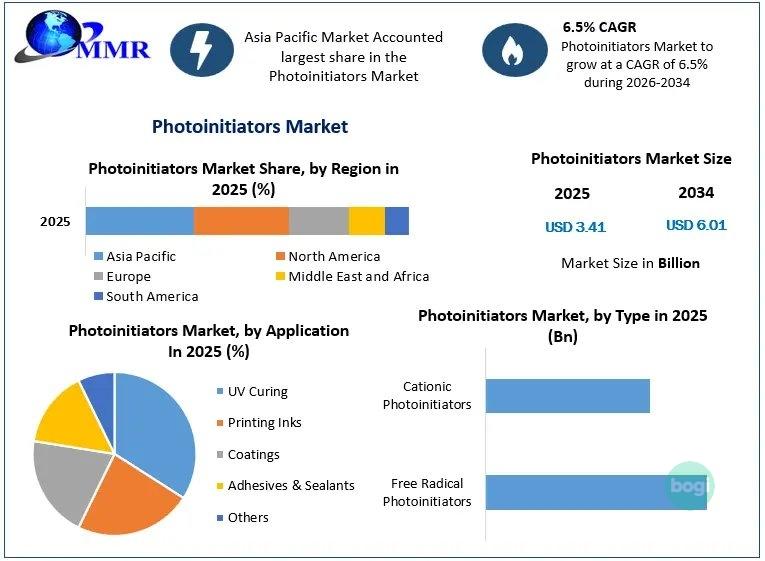
The Photoinitiators Market is entering a period of sustained expansion as demand increases for faster curing, energy-efficient manufacturing, low-emission coatings, high-performance printing inks, adhesives, electronics materials, and advanced 3D printing applications. According to Maximize Market Research, the global Photoinitiators Market was valued at USD 3.41 billion in 2025 and is projected to reach nearly USD 6.01 billion by 2034, expanding at a CAGR of 6.5% from 2026 to 2034.
Photoinitiators are essential chemical compounds that generate reactive species when exposed to UV or visible radiation, initiating polymerization and enabling rapid curing. Their ability to improve productivity, finishing quality, formulation flexibility, curing speed, storage stability, and application efficiency is supporting adoption across multiple industrial sectors.
Market Estimation, Growth Drivers and Opportunities
The market's growth is closely linked to the increasing adoption of UV-curable coatings and adhesives. UV curing enables rapid processing with reduced heat exposure and comparatively low VOC emissions, making it attractive for manufacturers seeking higher production efficiency and improved environmental performance. Growing applications in packaging, automotive, electronics, printing, industrial coatings, adhesives, and 3D printing are creating additional opportunities.
The transition toward ecological and energy-efficient products is another important market driver. Photoinitiator-based formulations can support faster production cycles while delivering attractive appearance, chemical resistance, corrosion protection, and durable finishes. Demand for advanced packaging and automotive coatings is also opening opportunities for specialty photoinitiator formulations.
However, volatility in raw-material prices remains a challenge for manufacturers. Differences in petroleum- and non-petroleum-based feedstock costs can affect production economics and product pricing. Regulatory requirements surrounding specific photoinitiator chemistries are also encouraging manufacturers to invest in safer, lower-migration, and more sustainable alternatives.
Request a Sample PDF of the Market Report : https://www.maximizemarketresearch.com/request-sample/72157/
Photoinitiators Market to Reach USD 6.01 Billion by 2034, Driven by UV Curing, Sustainable Coatings and Advanced Printing Technologies
The Photoinitiators Market is entering a period of sustained expansion as demand increases for faster curing, energy-efficient manufacturing, low-emission coatings, high-performance printing inks, adhesives, electronics materials, and advanced 3D printing applications. According to Maximize Market Research, the global Photoinitiators Market was valued at USD 3.41 billion in 2025 and is projected to reach nearly USD 6.01 billion by 2034, expanding at a CAGR of 6.5% from 2026 to 2034.
Photoinitiators are essential chemical compounds that generate reactive species when exposed to UV or visible radiation, initiating polymerization and enabling rapid curing. Their ability to improve productivity, finishing quality, formulation flexibility, curing speed, storage stability, and application efficiency is supporting adoption across multiple industrial sectors.
Market Estimation, Growth Drivers and Opportunities
The market's growth is closely linked to the increasing adoption of UV-curable coatings and adhesives. UV curing enables rapid processing with reduced heat exposure and comparatively low VOC emissions, making it attractive for manufacturers seeking higher production efficiency and improved environmental performance. Growing applications in packaging, automotive, electronics, printing, industrial coatings, adhesives, and 3D printing are creating additional opportunities.
The transition toward ecological and energy-efficient products is another important market driver. Photoinitiator-based formulations can support faster production cycles while delivering attractive appearance, chemical resistance, corrosion protection, and durable finishes. Demand for advanced packaging and automotive coatings is also opening opportunities for specialty photoinitiator formulations.
However, volatility in raw-material prices remains a challenge for manufacturers. Differences in petroleum- and non-petroleum-based feedstock costs can affect production economics and product pricing. Regulatory requirements surrounding specific photoinitiator chemistries are also encouraging manufacturers to invest in safer, lower-migration, and more sustainable alternatives.
Request a Sample PDF of the Market Report : https://www.maximizemarketresearch.com/request-sample/72157/
Photoinitiators Market Analysis and Future Development Trends
Photoinitiators Market to Reach USD 6.01 Billion by 2034, Driven by UV Curing, Sustainable Coatings and Advanced Printing Technologies
The Photoinitiators Market is entering a period of sustained expansion as demand increases for faster curing, energy-efficient manufacturing, low-emission coatings, high-performance printing inks, adhesives, electronics materials, and advanced 3D printing applications. According to Maximize Market Research, the global Photoinitiators Market was valued at USD 3.41 billion in 2025 and is projected to reach nearly USD 6.01 billion by 2034, expanding at a CAGR of 6.5% from 2026 to 2034.
Photoinitiators are essential chemical compounds that generate reactive species when exposed to UV or visible radiation, initiating polymerization and enabling rapid curing. Their ability to improve productivity, finishing quality, formulation flexibility, curing speed, storage stability, and application efficiency is supporting adoption across multiple industrial sectors.
Market Estimation, Growth Drivers and Opportunities
The market's growth is closely linked to the increasing adoption of UV-curable coatings and adhesives. UV curing enables rapid processing with reduced heat exposure and comparatively low VOC emissions, making it attractive for manufacturers seeking higher production efficiency and improved environmental performance. Growing applications in packaging, automotive, electronics, printing, industrial coatings, adhesives, and 3D printing are creating additional opportunities.
The transition toward ecological and energy-efficient products is another important market driver. Photoinitiator-based formulations can support faster production cycles while delivering attractive appearance, chemical resistance, corrosion protection, and durable finishes. Demand for advanced packaging and automotive coatings is also opening opportunities for specialty photoinitiator formulations.
However, volatility in raw-material prices remains a challenge for manufacturers. Differences in petroleum- and non-petroleum-based feedstock costs can affect production economics and product pricing. Regulatory requirements surrounding specific photoinitiator chemistries are also encouraging manufacturers to invest in safer, lower-migration, and more sustainable alternatives.
Request a Sample PDF of the Market Report : https://www.maximizemarketresearch.com/request-sample/72157/
0 التعليقات
0 المشاركات
375 مشاهدة

 English
 French
 Spanish
 Portuguese
 Deutsch
 Turkish
 Dutch
Dutch
 Italiano
 Russian
 Romaian
 Portuguese (Brazil)
 Greek
Greek