


Paraxylene Market Growth Drivers Shaping Future Industry Demand
Paraxylene Market Set to Reach USD 95.11 Billion by 2032 as Polyester, PET and Sustainable Chemical Demand Accelerate
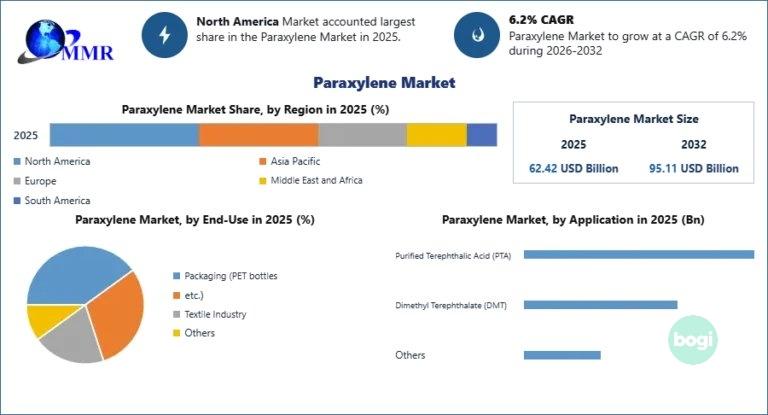
The Paraxylene Market is entering a strong expansion phase as polyester consumption, packaging demand, textile production, and petrochemical investment reshape the aromatics value chain. According to Maximize Market Research, the Paraxylene Market was valued at USD 62.42 Billion in 2025 and is projected to grow at a CAGR of 6.2% from 2026 to 2032, reaching nearly USD 95.11 Billion by 2032. Paraxylene is a key aromatic hydrocarbon used primarily to manufacture purified terephthalic acid (PTA), supporting polyester fibers and PET materials.
Market Estimation, Growth Drivers and Opportunities
Outlook is supported by demand for polyester fabrics and PET. Around two-thirds of paraxylene production is utilized in polyester-related applications, making textile consumption a fundamental demand driver. Urbanization, rising disposable incomes, apparel consumption, and expanding PET packaging use are creating additional demand. PET combines strength, durability, transparency, low cost, and recyclability, supporting packaging adoption.
A major opportunity is bio-based paraxylene and lower-carbon production. Producers are exploring renewable feedstocks, advanced catalysts, process optimization, and circular-economy technologies to reduce emissions while maintaining conventional polyester performance. Expansion of integrated refinery-petrochemical complexes, particularly in Asia, can improve feedstock security, efficiency, and logistics. These trends favor producers combining scale, integration, and sustainable technology.
Request Your Sample Report Now : https://www.maximizemarketresearch.com/request-sample/14720/
U.S. Market Trends and Investment
The U.S. paraxylene market is benefiting from its mature refining and petrochemical infrastructure, packaging demand, and integrated Gulf Coast supply chains. In 2025, ExxonMobil reported approximately USD 29.0 Billion in total cash capital expenditures and continued spending across its integrated refining and chemical portfolio. Its U.S. operations include integrated sites in Texas and Louisiana, supporting feedstock flexibility and chemical manufacturing.
Another important trend is the expansion of advanced recycling. ExxonMobil announced more than USD 200 Million of investment to expand advanced recycling operations at Baytown and Beaumont, with new capacity planned for 2026. This recycling investment can strengthen circular PET value chains and create opportunities for lower-carbon feedstocks.
Largest Market Segments
By application, Purified Terephthalic Acid (PTA) holds the largest share of the global paraxylene market. PTA is the principal intermediate for polyester production and is therefore directly linked to textile fibers, PET resins, films, and packaging.
By end use, the Textile Industry dominates the market because paraxylene-derived polyester is extensively used in apparel, home furnishings, technical textiles, and industrial fabrics.
Competitive Analysis: Leading Companies
JX Nippon Oil & Energy Corp. is a major integrated energy and chemical participant in Japan and Asia. Its refinery integration supports paraxylene competitiveness.
Reliance Industries Ltd. benefits from large-scale refinery and petrochemical integration, enabling efficient production of aromatics and downstream materials. Its scale and access to expanding Indian polyester and packaging demand provide opportunities for continued market growth.
CNPC is a major integrated Chinese energy and petrochemical company. China’s large paraxylene capacity base and expanding downstream polyester industry provide CNPC with a strong platform. Integrated complexes and technology upgrades can improve production economics.
Paraxylene Market Set to Reach USD 95.11 Billion by 2032 as Polyester, PET and Sustainable Chemical Demand Accelerate
The Paraxylene Market is entering a strong expansion phase as polyester consumption, packaging demand, textile production, and petrochemical investment reshape the aromatics value chain. According to Maximize Market Research, the Paraxylene Market was valued at USD 62.42 Billion in 2025 and is projected to grow at a CAGR of 6.2% from 2026 to 2032, reaching nearly USD 95.11 Billion by 2032. Paraxylene is a key aromatic hydrocarbon used primarily to manufacture purified terephthalic acid (PTA), supporting polyester fibers and PET materials.
Market Estimation, Growth Drivers and Opportunities
Outlook is supported by demand for polyester fabrics and PET. Around two-thirds of paraxylene production is utilized in polyester-related applications, making textile consumption a fundamental demand driver. Urbanization, rising disposable incomes, apparel consumption, and expanding PET packaging use are creating additional demand. PET combines strength, durability, transparency, low cost, and recyclability, supporting packaging adoption.
A major opportunity is bio-based paraxylene and lower-carbon production. Producers are exploring renewable feedstocks, advanced catalysts, process optimization, and circular-economy technologies to reduce emissions while maintaining conventional polyester performance. Expansion of integrated refinery-petrochemical complexes, particularly in Asia, can improve feedstock security, efficiency, and logistics. These trends favor producers combining scale, integration, and sustainable technology.
Request Your Sample Report Now : https://www.maximizemarketresearch.com/request-sample/14720/
U.S. Market Trends and Investment
The U.S. paraxylene market is benefiting from its mature refining and petrochemical infrastructure, packaging demand, and integrated Gulf Coast supply chains. In 2025, ExxonMobil reported approximately USD 29.0 Billion in total cash capital expenditures and continued spending across its integrated refining and chemical portfolio. Its U.S. operations include integrated sites in Texas and Louisiana, supporting feedstock flexibility and chemical manufacturing.
Another important trend is the expansion of advanced recycling. ExxonMobil announced more than USD 200 Million of investment to expand advanced recycling operations at Baytown and Beaumont, with new capacity planned for 2026. This recycling investment can strengthen circular PET value chains and create opportunities for lower-carbon feedstocks.
Largest Market Segments
By application, Purified Terephthalic Acid (PTA) holds the largest share of the global paraxylene market. PTA is the principal intermediate for polyester production and is therefore directly linked to textile fibers, PET resins, films, and packaging.
By end use, the Textile Industry dominates the market because paraxylene-derived polyester is extensively used in apparel, home furnishings, technical textiles, and industrial fabrics.
Competitive Analysis: Leading Companies
JX Nippon Oil & Energy Corp. is a major integrated energy and chemical participant in Japan and Asia. Its refinery integration supports paraxylene competitiveness.
Reliance Industries Ltd. benefits from large-scale refinery and petrochemical integration, enabling efficient production of aromatics and downstream materials. Its scale and access to expanding Indian polyester and packaging demand provide opportunities for continued market growth.
CNPC is a major integrated Chinese energy and petrochemical company. China’s large paraxylene capacity base and expanding downstream polyester industry provide CNPC with a strong platform. Integrated complexes and technology upgrades can improve production economics.
Paraxylene Market Growth Drivers Shaping Future Industry Demand
Paraxylene Market Set to Reach USD 95.11 Billion by 2032 as Polyester, PET and Sustainable Chemical Demand Accelerate
The Paraxylene Market is entering a strong expansion phase as polyester consumption, packaging demand, textile production, and petrochemical investment reshape the aromatics value chain. According to Maximize Market Research, the Paraxylene Market was valued at USD 62.42 Billion in 2025 and is projected to grow at a CAGR of 6.2% from 2026 to 2032, reaching nearly USD 95.11 Billion by 2032. Paraxylene is a key aromatic hydrocarbon used primarily to manufacture purified terephthalic acid (PTA), supporting polyester fibers and PET materials.
Market Estimation, Growth Drivers and Opportunities
Outlook is supported by demand for polyester fabrics and PET. Around two-thirds of paraxylene production is utilized in polyester-related applications, making textile consumption a fundamental demand driver. Urbanization, rising disposable incomes, apparel consumption, and expanding PET packaging use are creating additional demand. PET combines strength, durability, transparency, low cost, and recyclability, supporting packaging adoption.
A major opportunity is bio-based paraxylene and lower-carbon production. Producers are exploring renewable feedstocks, advanced catalysts, process optimization, and circular-economy technologies to reduce emissions while maintaining conventional polyester performance. Expansion of integrated refinery-petrochemical complexes, particularly in Asia, can improve feedstock security, efficiency, and logistics. These trends favor producers combining scale, integration, and sustainable technology.
Request Your Sample Report Now : https://www.maximizemarketresearch.com/request-sample/14720/
U.S. Market Trends and Investment
The U.S. paraxylene market is benefiting from its mature refining and petrochemical infrastructure, packaging demand, and integrated Gulf Coast supply chains. In 2025, ExxonMobil reported approximately USD 29.0 Billion in total cash capital expenditures and continued spending across its integrated refining and chemical portfolio. Its U.S. operations include integrated sites in Texas and Louisiana, supporting feedstock flexibility and chemical manufacturing.
Another important trend is the expansion of advanced recycling. ExxonMobil announced more than USD 200 Million of investment to expand advanced recycling operations at Baytown and Beaumont, with new capacity planned for 2026. This recycling investment can strengthen circular PET value chains and create opportunities for lower-carbon feedstocks.
Largest Market Segments
By application, Purified Terephthalic Acid (PTA) holds the largest share of the global paraxylene market. PTA is the principal intermediate for polyester production and is therefore directly linked to textile fibers, PET resins, films, and packaging.
By end use, the Textile Industry dominates the market because paraxylene-derived polyester is extensively used in apparel, home furnishings, technical textiles, and industrial fabrics.
Competitive Analysis: Leading Companies
JX Nippon Oil & Energy Corp. is a major integrated energy and chemical participant in Japan and Asia. Its refinery integration supports paraxylene competitiveness.
Reliance Industries Ltd. benefits from large-scale refinery and petrochemical integration, enabling efficient production of aromatics and downstream materials. Its scale and access to expanding Indian polyester and packaging demand provide opportunities for continued market growth.
CNPC is a major integrated Chinese energy and petrochemical company. China’s large paraxylene capacity base and expanding downstream polyester industry provide CNPC with a strong platform. Integrated complexes and technology upgrades can improve production economics.
0 Comments
0 Shares
777 Views

 Arabic
 French
 Spanish
 Portuguese
 Deutsch
 Turkish
 Dutch
Dutch
 Italiano
 Russian
 Romaian
 Portuguese (Brazil)
 Greek
Greek