


Pectin Market Analysis, Development Trends, and Future Industry Outlook
Key Highlights
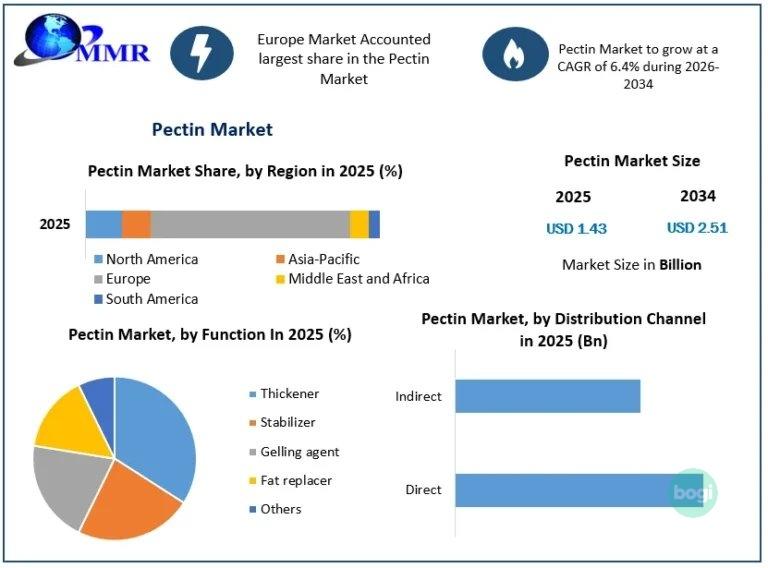
The Pectin Market was valued at USD 1.43 billion in 2025, establishing a commercial base.
Revenue is projected to reach nearly USD 2.51 billion by 2034 at a 6.4% CAGR from 2026 to 2034.
Food and beverage, pharmaceuticals, bakery, and dairy applications create multiple demand channels.
Europe holds the largest market share, while Asia Pacific offers significant growth potential.
Raw-material availability remains a critical issue because citrus-fruit conditions can affect supply and pricing.
Market Overview
The Pectin Market is moving beyond its traditional role in jams and jellies as manufacturers seek functional, plant-derived ingredients with broader applications. Pectin, a polysaccharide found in fruits and vegetables, is extracted largely from apple waste and citrus peels and functions as a thickener, stabilizer, emulsifier, and gelling agent. This versatility gives processors opportunities to improve texture, shelf life, and product performance across several industries.
Why This Market Matters Now
For ingredient buyers and manufacturers, the Pectin Market matters because demand is supported by several end-use industries rather than a single application. Food and beverage producers use pectin in fruit products, dairy products, bakery items, sweets, jams, and jellies. Pharmaceutical and cosmetics applications add commercial reach, while interest in plant-based products strengthens its positioning as a natural alternative to synthetic ingredients. This creates a broader demand base for suppliers.
Key Trends Driving Growth
A major trend is the expanding use of pectin as a gelling, thickening, and stabilizing ingredient. Low-methoxyl pectin is particularly favored because it requires less sugar to form gels, supporting food and beverage applications. The Pectin Market is also benefiting from interest in vegan and plant-based products, as pectin is fat- and cholesterol-free and contains fiber.
Healthcare and personal-care applications are widening the opportunity. The report highlights pectin use in dietary supplements, pharmaceuticals, specialty medical adhesives, and cosmetics, where it can function as an emulsifier or stabilizer. Rising dairy consumption and greater health awareness provide additional demand channels, strengthening the market’s cross-industry appeal.
Get Your Free Sample Report Link : https://www.maximizemarketresearch.com/request-sample/24347/
Key Highlights
The Pectin Market was valued at USD 1.43 billion in 2025, establishing a commercial base.
Revenue is projected to reach nearly USD 2.51 billion by 2034 at a 6.4% CAGR from 2026 to 2034.
Food and beverage, pharmaceuticals, bakery, and dairy applications create multiple demand channels.
Europe holds the largest market share, while Asia Pacific offers significant growth potential.
Raw-material availability remains a critical issue because citrus-fruit conditions can affect supply and pricing.
Market Overview
The Pectin Market is moving beyond its traditional role in jams and jellies as manufacturers seek functional, plant-derived ingredients with broader applications. Pectin, a polysaccharide found in fruits and vegetables, is extracted largely from apple waste and citrus peels and functions as a thickener, stabilizer, emulsifier, and gelling agent. This versatility gives processors opportunities to improve texture, shelf life, and product performance across several industries.
Why This Market Matters Now
For ingredient buyers and manufacturers, the Pectin Market matters because demand is supported by several end-use industries rather than a single application. Food and beverage producers use pectin in fruit products, dairy products, bakery items, sweets, jams, and jellies. Pharmaceutical and cosmetics applications add commercial reach, while interest in plant-based products strengthens its positioning as a natural alternative to synthetic ingredients. This creates a broader demand base for suppliers.
Key Trends Driving Growth
A major trend is the expanding use of pectin as a gelling, thickening, and stabilizing ingredient. Low-methoxyl pectin is particularly favored because it requires less sugar to form gels, supporting food and beverage applications. The Pectin Market is also benefiting from interest in vegan and plant-based products, as pectin is fat- and cholesterol-free and contains fiber.
Healthcare and personal-care applications are widening the opportunity. The report highlights pectin use in dietary supplements, pharmaceuticals, specialty medical adhesives, and cosmetics, where it can function as an emulsifier or stabilizer. Rising dairy consumption and greater health awareness provide additional demand channels, strengthening the market’s cross-industry appeal.
Get Your Free Sample Report Link : https://www.maximizemarketresearch.com/request-sample/24347/
Pectin Market Analysis, Development Trends, and Future Industry Outlook
Key Highlights
The Pectin Market was valued at USD 1.43 billion in 2025, establishing a commercial base.
Revenue is projected to reach nearly USD 2.51 billion by 2034 at a 6.4% CAGR from 2026 to 2034.
Food and beverage, pharmaceuticals, bakery, and dairy applications create multiple demand channels.
Europe holds the largest market share, while Asia Pacific offers significant growth potential.
Raw-material availability remains a critical issue because citrus-fruit conditions can affect supply and pricing.
Market Overview
The Pectin Market is moving beyond its traditional role in jams and jellies as manufacturers seek functional, plant-derived ingredients with broader applications. Pectin, a polysaccharide found in fruits and vegetables, is extracted largely from apple waste and citrus peels and functions as a thickener, stabilizer, emulsifier, and gelling agent. This versatility gives processors opportunities to improve texture, shelf life, and product performance across several industries.
Why This Market Matters Now
For ingredient buyers and manufacturers, the Pectin Market matters because demand is supported by several end-use industries rather than a single application. Food and beverage producers use pectin in fruit products, dairy products, bakery items, sweets, jams, and jellies. Pharmaceutical and cosmetics applications add commercial reach, while interest in plant-based products strengthens its positioning as a natural alternative to synthetic ingredients. This creates a broader demand base for suppliers.
Key Trends Driving Growth
A major trend is the expanding use of pectin as a gelling, thickening, and stabilizing ingredient. Low-methoxyl pectin is particularly favored because it requires less sugar to form gels, supporting food and beverage applications. The Pectin Market is also benefiting from interest in vegan and plant-based products, as pectin is fat- and cholesterol-free and contains fiber.
Healthcare and personal-care applications are widening the opportunity. The report highlights pectin use in dietary supplements, pharmaceuticals, specialty medical adhesives, and cosmetics, where it can function as an emulsifier or stabilizer. Rising dairy consumption and greater health awareness provide additional demand channels, strengthening the market’s cross-industry appeal.
Get Your Free Sample Report Link : https://www.maximizemarketresearch.com/request-sample/24347/
0 Комментарии
0 Поделились
583 Просмотры

 English
 Arabic
 French
 Spanish
 Portuguese
 Deutsch
 Turkish
 Dutch
Dutch
 Italiano
 Romaian
 Portuguese (Brazil)
 Greek
Greek