


Agricultural Films Market Demand, Growth Drivers, and Industry Development Analysis
Key Highlights
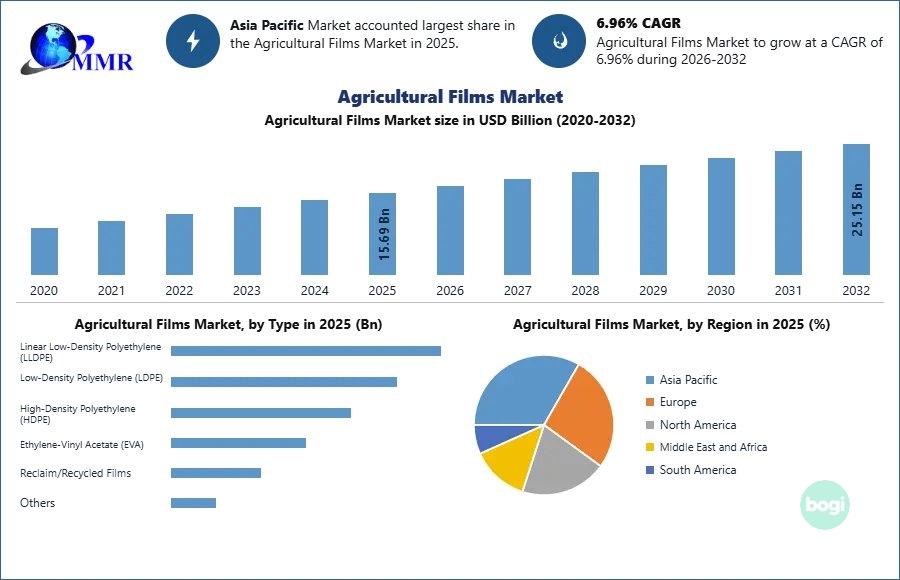
The Agricultural Films Market was valued at USD 15.7 billion in 2025, establishing a substantial commercial base for producers and suppliers.
The market is projected to grow at a 6.96% CAGR from 2026 to 2032, signaling sustained demand.
LLDPE is projected to record the highest CAGR among material types at 34.5%.
Greenhouse films are expected to achieve the highest application CAGR of 30%.
Asia Pacific held the largest market share in 2025 and is expected to maintain significant growth.
Market Overview
The Agricultural Films Market is becoming an important component of modern crop production. These films help protect crops from adverse weather, weeds, pests, and moisture loss while supporting temperature and humidity management. The 2025 valuation of USD 15.7 billion indicates strong commercial adoption across agricultural applications.
The market covers LLDPE, LDPE, HDPE, EVA, reclaim/recycled films, and other materials. Applications include greenhouse films, mulching films, silage films, and crop protection films. This broad product base gives manufacturers multiple routes to address changing farming requirements.
Why This Market Matters Now
Food production is increasingly being challenged by population growth, declining availability of suitable agricultural land, and climate-related disruptions. Consequently, farmers are looking for solutions that can improve productivity without relying solely on chemical-based crop protection.
The Agricultural Films Market benefits from this transition because films can support controlled growing environments and reduce evaporation. Government restrictions on chemical pesticides and weedicides are also creating opportunities for alternative crop-protection approaches.
However, sustainability remains a critical business issue. Improper disposal of plastic films can contribute to environmental pollution, while biodegradable alternatives currently face higher production costs. Manufacturers therefore need to balance performance, affordability, and environmental responsibility.
Get Your Free Sample Report Link : https://www.maximizemarketresearch.com/request-sample/42869/
Key Trends Driving Growth
One major trend is the development of biodegradable and compostable agricultural films. These products offer an alternative to conventional polyethylene mulch because certain biodegradable films can remain in the soil and be incorporated after use.
Climate change is another major demand catalyst. Greenhouse films help maintain crop-specific conditions, while silage films support preservation of nutritional value. As weather patterns become more challenging, controlled agricultural environments can become increasingly valuable.
Product innovation is also expanding. UV-blocking, NIR-blocking, fluorescent, and ultra-thermic films are highlighted as technologies capable of supporting market expansion, particularly in developed agricultural applications.
Key Highlights
The Agricultural Films Market was valued at USD 15.7 billion in 2025, establishing a substantial commercial base for producers and suppliers.
The market is projected to grow at a 6.96% CAGR from 2026 to 2032, signaling sustained demand.
LLDPE is projected to record the highest CAGR among material types at 34.5%.
Greenhouse films are expected to achieve the highest application CAGR of 30%.
Asia Pacific held the largest market share in 2025 and is expected to maintain significant growth.
Market Overview
The Agricultural Films Market is becoming an important component of modern crop production. These films help protect crops from adverse weather, weeds, pests, and moisture loss while supporting temperature and humidity management. The 2025 valuation of USD 15.7 billion indicates strong commercial adoption across agricultural applications.
The market covers LLDPE, LDPE, HDPE, EVA, reclaim/recycled films, and other materials. Applications include greenhouse films, mulching films, silage films, and crop protection films. This broad product base gives manufacturers multiple routes to address changing farming requirements.
Why This Market Matters Now
Food production is increasingly being challenged by population growth, declining availability of suitable agricultural land, and climate-related disruptions. Consequently, farmers are looking for solutions that can improve productivity without relying solely on chemical-based crop protection.
The Agricultural Films Market benefits from this transition because films can support controlled growing environments and reduce evaporation. Government restrictions on chemical pesticides and weedicides are also creating opportunities for alternative crop-protection approaches.
However, sustainability remains a critical business issue. Improper disposal of plastic films can contribute to environmental pollution, while biodegradable alternatives currently face higher production costs. Manufacturers therefore need to balance performance, affordability, and environmental responsibility.
Get Your Free Sample Report Link : https://www.maximizemarketresearch.com/request-sample/42869/
Key Trends Driving Growth
One major trend is the development of biodegradable and compostable agricultural films. These products offer an alternative to conventional polyethylene mulch because certain biodegradable films can remain in the soil and be incorporated after use.
Climate change is another major demand catalyst. Greenhouse films help maintain crop-specific conditions, while silage films support preservation of nutritional value. As weather patterns become more challenging, controlled agricultural environments can become increasingly valuable.
Product innovation is also expanding. UV-blocking, NIR-blocking, fluorescent, and ultra-thermic films are highlighted as technologies capable of supporting market expansion, particularly in developed agricultural applications.
Agricultural Films Market Demand, Growth Drivers, and Industry Development Analysis
Key Highlights
The Agricultural Films Market was valued at USD 15.7 billion in 2025, establishing a substantial commercial base for producers and suppliers.
The market is projected to grow at a 6.96% CAGR from 2026 to 2032, signaling sustained demand.
LLDPE is projected to record the highest CAGR among material types at 34.5%.
Greenhouse films are expected to achieve the highest application CAGR of 30%.
Asia Pacific held the largest market share in 2025 and is expected to maintain significant growth.
Market Overview
The Agricultural Films Market is becoming an important component of modern crop production. These films help protect crops from adverse weather, weeds, pests, and moisture loss while supporting temperature and humidity management. The 2025 valuation of USD 15.7 billion indicates strong commercial adoption across agricultural applications.
The market covers LLDPE, LDPE, HDPE, EVA, reclaim/recycled films, and other materials. Applications include greenhouse films, mulching films, silage films, and crop protection films. This broad product base gives manufacturers multiple routes to address changing farming requirements.
Why This Market Matters Now
Food production is increasingly being challenged by population growth, declining availability of suitable agricultural land, and climate-related disruptions. Consequently, farmers are looking for solutions that can improve productivity without relying solely on chemical-based crop protection.
The Agricultural Films Market benefits from this transition because films can support controlled growing environments and reduce evaporation. Government restrictions on chemical pesticides and weedicides are also creating opportunities for alternative crop-protection approaches.
However, sustainability remains a critical business issue. Improper disposal of plastic films can contribute to environmental pollution, while biodegradable alternatives currently face higher production costs. Manufacturers therefore need to balance performance, affordability, and environmental responsibility.
Get Your Free Sample Report Link : https://www.maximizemarketresearch.com/request-sample/42869/
Key Trends Driving Growth
One major trend is the development of biodegradable and compostable agricultural films. These products offer an alternative to conventional polyethylene mulch because certain biodegradable films can remain in the soil and be incorporated after use.
Climate change is another major demand catalyst. Greenhouse films help maintain crop-specific conditions, while silage films support preservation of nutritional value. As weather patterns become more challenging, controlled agricultural environments can become increasingly valuable.
Product innovation is also expanding. UV-blocking, NIR-blocking, fluorescent, and ultra-thermic films are highlighted as technologies capable of supporting market expansion, particularly in developed agricultural applications.
0 Комментарии
0 Поделились
542 Просмотры

 English
 Arabic
 French
 Spanish
 Portuguese
 Deutsch
 Turkish
 Dutch
Dutch
 Italiano
 Romaian
 Portuguese (Brazil)
 Greek
Greek