


LED Video Walls Market Growth, Future Opportunities, and Industry Outlook
Key Highlights
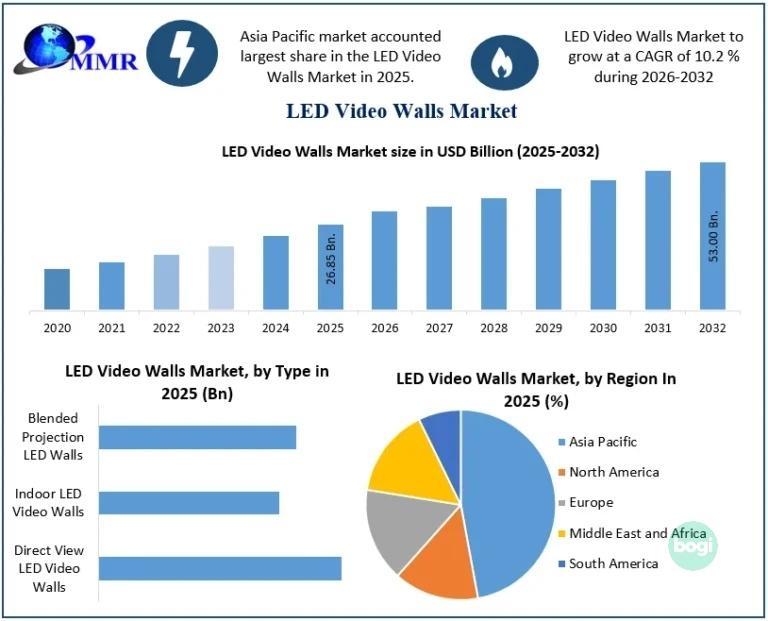
The LED Video Walls Market was valued at USD 26.85 billion in 2025, creating a substantial commercial base for display technology suppliers.
Revenue is expected to reach nearly USD 53.00 billion by 2032, indicating strong expansion opportunities for manufacturers and investors.
The market is projected to grow at a CAGR of 10.2% from 2026 to 2032, reflecting sustained demand for advanced visual experiences.
Direct View LED Video Walls dominated the type segment in 2025 because of strong image quality, brightness, flexibility, and broad application potential.
Asia Pacific led the market in 2025, supported by urbanization, digital advertising activity, and display technology investments.
Market Overview
The LED Video Walls Market is shifting from conventional display infrastructure toward high-impact visual communication systems. LED video walls combine multiple light-emitting diodes to create large-format displays for videos, images, text, and graphics without visible seams. Their brightness, clarity, vivid colors, and flexible configurations make them suitable for both indoor and outdoor environments.
The market reached USD 26.85 billion in 2025, establishing a strong revenue foundation. This scale signals that organizations increasingly view large-format digital displays as tools for engagement, branding, entertainment, and information delivery rather than standalone hardware purchases.
Why This Market Matters Now
The LED Video Walls Market matters because businesses increasingly need visual systems capable of operating continuously while delivering high-impact content. Advertising, broadcasting, retail, airports, live events, and public spaces all require displays that can attract attention quickly.
At the same time, technical complexity remains a consideration. Compatibility, interoperability, software updates, installation, maintenance, and continuous training can increase ownership challenges. This creates opportunities for suppliers offering reliable systems, easier installation, and application-specific solutions.
Get a Sample Insight Report Now : https://www.maximizemarketresearch.com/request-sample/16506/
Key Trends Driving Growth
A major trend is the demand for enhanced visual experiences. LED technology provides brightness and clarity that support immersive environments across advertising, broadcasting, and live events. Customizable sizes, shapes, and resolutions also allow buyers to tailor installations to specific locations.
Energy efficiency and affordability are becoming increasingly important as technology improves. These developments can broaden adoption while encouraging manufacturers to compete through product performance, operating efficiency, and installation flexibility.
Key Highlights
The LED Video Walls Market was valued at USD 26.85 billion in 2025, creating a substantial commercial base for display technology suppliers.
Revenue is expected to reach nearly USD 53.00 billion by 2032, indicating strong expansion opportunities for manufacturers and investors.
The market is projected to grow at a CAGR of 10.2% from 2026 to 2032, reflecting sustained demand for advanced visual experiences.
Direct View LED Video Walls dominated the type segment in 2025 because of strong image quality, brightness, flexibility, and broad application potential.
Asia Pacific led the market in 2025, supported by urbanization, digital advertising activity, and display technology investments.
Market Overview
The LED Video Walls Market is shifting from conventional display infrastructure toward high-impact visual communication systems. LED video walls combine multiple light-emitting diodes to create large-format displays for videos, images, text, and graphics without visible seams. Their brightness, clarity, vivid colors, and flexible configurations make them suitable for both indoor and outdoor environments.
The market reached USD 26.85 billion in 2025, establishing a strong revenue foundation. This scale signals that organizations increasingly view large-format digital displays as tools for engagement, branding, entertainment, and information delivery rather than standalone hardware purchases.
Why This Market Matters Now
The LED Video Walls Market matters because businesses increasingly need visual systems capable of operating continuously while delivering high-impact content. Advertising, broadcasting, retail, airports, live events, and public spaces all require displays that can attract attention quickly.
At the same time, technical complexity remains a consideration. Compatibility, interoperability, software updates, installation, maintenance, and continuous training can increase ownership challenges. This creates opportunities for suppliers offering reliable systems, easier installation, and application-specific solutions.
Get a Sample Insight Report Now : https://www.maximizemarketresearch.com/request-sample/16506/
Key Trends Driving Growth
A major trend is the demand for enhanced visual experiences. LED technology provides brightness and clarity that support immersive environments across advertising, broadcasting, and live events. Customizable sizes, shapes, and resolutions also allow buyers to tailor installations to specific locations.
Energy efficiency and affordability are becoming increasingly important as technology improves. These developments can broaden adoption while encouraging manufacturers to compete through product performance, operating efficiency, and installation flexibility.
LED Video Walls Market Growth, Future Opportunities, and Industry Outlook
Key Highlights
The LED Video Walls Market was valued at USD 26.85 billion in 2025, creating a substantial commercial base for display technology suppliers.
Revenue is expected to reach nearly USD 53.00 billion by 2032, indicating strong expansion opportunities for manufacturers and investors.
The market is projected to grow at a CAGR of 10.2% from 2026 to 2032, reflecting sustained demand for advanced visual experiences.
Direct View LED Video Walls dominated the type segment in 2025 because of strong image quality, brightness, flexibility, and broad application potential.
Asia Pacific led the market in 2025, supported by urbanization, digital advertising activity, and display technology investments.
Market Overview
The LED Video Walls Market is shifting from conventional display infrastructure toward high-impact visual communication systems. LED video walls combine multiple light-emitting diodes to create large-format displays for videos, images, text, and graphics without visible seams. Their brightness, clarity, vivid colors, and flexible configurations make them suitable for both indoor and outdoor environments.
The market reached USD 26.85 billion in 2025, establishing a strong revenue foundation. This scale signals that organizations increasingly view large-format digital displays as tools for engagement, branding, entertainment, and information delivery rather than standalone hardware purchases.
Why This Market Matters Now
The LED Video Walls Market matters because businesses increasingly need visual systems capable of operating continuously while delivering high-impact content. Advertising, broadcasting, retail, airports, live events, and public spaces all require displays that can attract attention quickly.
At the same time, technical complexity remains a consideration. Compatibility, interoperability, software updates, installation, maintenance, and continuous training can increase ownership challenges. This creates opportunities for suppliers offering reliable systems, easier installation, and application-specific solutions.
Get a Sample Insight Report Now : https://www.maximizemarketresearch.com/request-sample/16506/
Key Trends Driving Growth
A major trend is the demand for enhanced visual experiences. LED technology provides brightness and clarity that support immersive environments across advertising, broadcasting, and live events. Customizable sizes, shapes, and resolutions also allow buyers to tailor installations to specific locations.
Energy efficiency and affordability are becoming increasingly important as technology improves. These developments can broaden adoption while encouraging manufacturers to compete through product performance, operating efficiency, and installation flexibility.
0 التعليقات
0 المشاركات
891 مشاهدة

 English
 French
 Spanish
 Portuguese
 Deutsch
 Turkish
 Dutch
Dutch
 Italiano
 Russian
 Romaian
 Portuguese (Brazil)
 Greek
Greek