


Intermodal Freight Transportation Market Industry Overview, and Key Developments
Key Highlights
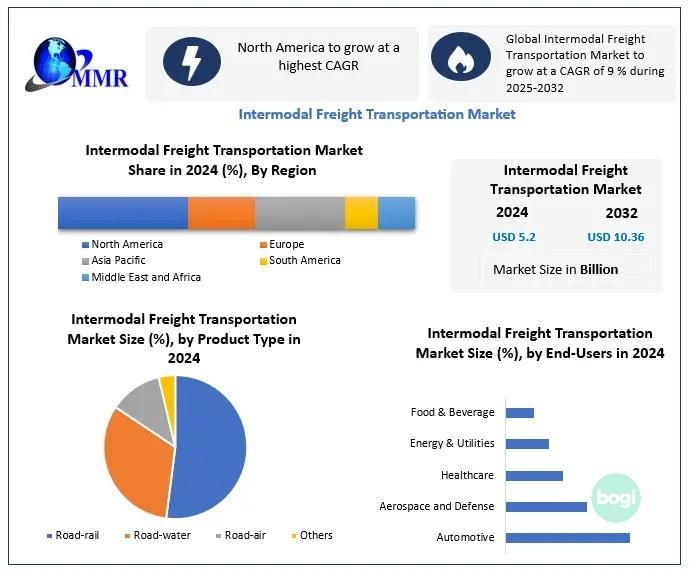
Intermodal Freight Transportation Market was valued at USD 5.2 Billion in 2024.
The market is projected to reach nearly USD 10.36 Billion by 2032.
The market is expected to grow at a CAGR of 9% from 2025 to 2032.
Growth is supported by expanding global trade and standardized container usage.
Advanced cross-border logistics infrastructure continues to improve transportation efficiency.
Digital technologies are strengthening visibility across freight operations.
Market Overview
The Intermodal Freight Transportation Market is evolving into a critical component of modern logistics as companies seek reliable, flexible, and cost-effective freight movement. The market was valued at USD 5.2 Billion in 2024 and is projected to reach nearly USD 10.36 Billion by 2032, growing at a CAGR of 9% during the forecast period. This steady expansion reflects increasing investment in integrated transportation networks, creating significant opportunities for logistics companies, transportation providers, infrastructure developers, and industrial manufacturers.
The growing adoption of standardized shipping containers has simplified cargo transfers between rail, road, sea, and other transportation modes. This operational efficiency enables businesses to reduce delays while improving cargo security and shipment visibility.
Why This Market Matters Now
Global supply chains have become increasingly complex, making transportation flexibility a competitive advantage rather than simply an operational necessity. The Intermodal Freight Transportation Market is helping businesses diversify transportation options while minimizing dependency on a single freight mode.
Companies involved in manufacturing, retail, automotive, chemicals, and consumer goods are placing greater emphasis on integrated logistics systems that improve delivery performance. As international trade volumes continue expanding, organizations are investing in transportation models capable of handling growing cargo demand while supporting business continuity.
At the same time, infrastructure modernization across major trade corridors is enabling smoother cross-border freight movement, reducing bottlenecks that previously affected delivery schedules.
Get a Sample Insight Report Now : https://www.maximizemarketresearch.com/request-sample/28077/
Key Trends Driving Growth
Several structural trends are accelerating the development of the Intermodal Freight Transportation Market. The continued expansion of international trade remains one of the strongest growth drivers, encouraging logistics companies to improve multimodal transportation capabilities.
Standardized containers have transformed cargo handling by allowing seamless transfers between ships, trains, and trucks without unloading individual shipments. This improves operational efficiency while lowering handling costs.
Digital transformation is also reshaping freight transportation. Advanced logistics platforms, shipment tracking technologies, automation, and data-driven route optimization are improving visibility throughout the supply chain. Businesses benefit from better inventory planning, faster deliveries, and improved customer satisfaction.
Cross-border logistics infrastructure is another important growth factor. Investments in ports, rail networks, highways, and logistics hubs are strengthening transportation connectivity across major global trade routes.
Market Growth Outlook
The future outlook for the Intermodal Freight Transportation Market remains positive as organizations continue strengthening supply chain resilience. Rising freight volumes, expanding international commerce, and continuous improvements in transportation infrastructure are expected to support long-term market expansion.
Growing collaboration among logistics providers, transportation operators, and infrastructure developers is creating more integrated freight ecosystems. These partnerships allow businesses to optimize transportation routes while improving operational flexibility.
As companies continue modernizing logistics operations, demand for efficient intermodal transportation solutions is expected to increase across multiple industries, creating new investment opportunities throughout the freight transportation value chain.
Key Highlights
Intermodal Freight Transportation Market was valued at USD 5.2 Billion in 2024.
The market is projected to reach nearly USD 10.36 Billion by 2032.
The market is expected to grow at a CAGR of 9% from 2025 to 2032.
Growth is supported by expanding global trade and standardized container usage.
Advanced cross-border logistics infrastructure continues to improve transportation efficiency.
Digital technologies are strengthening visibility across freight operations.
Market Overview
The Intermodal Freight Transportation Market is evolving into a critical component of modern logistics as companies seek reliable, flexible, and cost-effective freight movement. The market was valued at USD 5.2 Billion in 2024 and is projected to reach nearly USD 10.36 Billion by 2032, growing at a CAGR of 9% during the forecast period. This steady expansion reflects increasing investment in integrated transportation networks, creating significant opportunities for logistics companies, transportation providers, infrastructure developers, and industrial manufacturers.
The growing adoption of standardized shipping containers has simplified cargo transfers between rail, road, sea, and other transportation modes. This operational efficiency enables businesses to reduce delays while improving cargo security and shipment visibility.
Why This Market Matters Now
Global supply chains have become increasingly complex, making transportation flexibility a competitive advantage rather than simply an operational necessity. The Intermodal Freight Transportation Market is helping businesses diversify transportation options while minimizing dependency on a single freight mode.
Companies involved in manufacturing, retail, automotive, chemicals, and consumer goods are placing greater emphasis on integrated logistics systems that improve delivery performance. As international trade volumes continue expanding, organizations are investing in transportation models capable of handling growing cargo demand while supporting business continuity.
At the same time, infrastructure modernization across major trade corridors is enabling smoother cross-border freight movement, reducing bottlenecks that previously affected delivery schedules.
Get a Sample Insight Report Now : https://www.maximizemarketresearch.com/request-sample/28077/
Key Trends Driving Growth
Several structural trends are accelerating the development of the Intermodal Freight Transportation Market. The continued expansion of international trade remains one of the strongest growth drivers, encouraging logistics companies to improve multimodal transportation capabilities.
Standardized containers have transformed cargo handling by allowing seamless transfers between ships, trains, and trucks without unloading individual shipments. This improves operational efficiency while lowering handling costs.
Digital transformation is also reshaping freight transportation. Advanced logistics platforms, shipment tracking technologies, automation, and data-driven route optimization are improving visibility throughout the supply chain. Businesses benefit from better inventory planning, faster deliveries, and improved customer satisfaction.
Cross-border logistics infrastructure is another important growth factor. Investments in ports, rail networks, highways, and logistics hubs are strengthening transportation connectivity across major global trade routes.
Market Growth Outlook
The future outlook for the Intermodal Freight Transportation Market remains positive as organizations continue strengthening supply chain resilience. Rising freight volumes, expanding international commerce, and continuous improvements in transportation infrastructure are expected to support long-term market expansion.
Growing collaboration among logistics providers, transportation operators, and infrastructure developers is creating more integrated freight ecosystems. These partnerships allow businesses to optimize transportation routes while improving operational flexibility.
As companies continue modernizing logistics operations, demand for efficient intermodal transportation solutions is expected to increase across multiple industries, creating new investment opportunities throughout the freight transportation value chain.
Intermodal Freight Transportation Market Industry Overview, and Key Developments
Key Highlights
Intermodal Freight Transportation Market was valued at USD 5.2 Billion in 2024.
The market is projected to reach nearly USD 10.36 Billion by 2032.
The market is expected to grow at a CAGR of 9% from 2025 to 2032.
Growth is supported by expanding global trade and standardized container usage.
Advanced cross-border logistics infrastructure continues to improve transportation efficiency.
Digital technologies are strengthening visibility across freight operations.
Market Overview
The Intermodal Freight Transportation Market is evolving into a critical component of modern logistics as companies seek reliable, flexible, and cost-effective freight movement. The market was valued at USD 5.2 Billion in 2024 and is projected to reach nearly USD 10.36 Billion by 2032, growing at a CAGR of 9% during the forecast period. This steady expansion reflects increasing investment in integrated transportation networks, creating significant opportunities for logistics companies, transportation providers, infrastructure developers, and industrial manufacturers.
The growing adoption of standardized shipping containers has simplified cargo transfers between rail, road, sea, and other transportation modes. This operational efficiency enables businesses to reduce delays while improving cargo security and shipment visibility.
Why This Market Matters Now
Global supply chains have become increasingly complex, making transportation flexibility a competitive advantage rather than simply an operational necessity. The Intermodal Freight Transportation Market is helping businesses diversify transportation options while minimizing dependency on a single freight mode.
Companies involved in manufacturing, retail, automotive, chemicals, and consumer goods are placing greater emphasis on integrated logistics systems that improve delivery performance. As international trade volumes continue expanding, organizations are investing in transportation models capable of handling growing cargo demand while supporting business continuity.
At the same time, infrastructure modernization across major trade corridors is enabling smoother cross-border freight movement, reducing bottlenecks that previously affected delivery schedules.
Get a Sample Insight Report Now : https://www.maximizemarketresearch.com/request-sample/28077/
Key Trends Driving Growth
Several structural trends are accelerating the development of the Intermodal Freight Transportation Market. The continued expansion of international trade remains one of the strongest growth drivers, encouraging logistics companies to improve multimodal transportation capabilities.
Standardized containers have transformed cargo handling by allowing seamless transfers between ships, trains, and trucks without unloading individual shipments. This improves operational efficiency while lowering handling costs.
Digital transformation is also reshaping freight transportation. Advanced logistics platforms, shipment tracking technologies, automation, and data-driven route optimization are improving visibility throughout the supply chain. Businesses benefit from better inventory planning, faster deliveries, and improved customer satisfaction.
Cross-border logistics infrastructure is another important growth factor. Investments in ports, rail networks, highways, and logistics hubs are strengthening transportation connectivity across major global trade routes.
Market Growth Outlook
The future outlook for the Intermodal Freight Transportation Market remains positive as organizations continue strengthening supply chain resilience. Rising freight volumes, expanding international commerce, and continuous improvements in transportation infrastructure are expected to support long-term market expansion.
Growing collaboration among logistics providers, transportation operators, and infrastructure developers is creating more integrated freight ecosystems. These partnerships allow businesses to optimize transportation routes while improving operational flexibility.
As companies continue modernizing logistics operations, demand for efficient intermodal transportation solutions is expected to increase across multiple industries, creating new investment opportunities throughout the freight transportation value chain.
0 Comentários
0 Compartilhamentos
836 Visualizações

 English
 Arabic
 French
 Spanish
 Portuguese
 Deutsch
 Turkish
 Dutch
Dutch
 Italiano
 Russian
 Romaian
 Greek
Greek