


Sulfur Market Industry Trends, Growth Opportunities and Market Analysis
Key Highlights
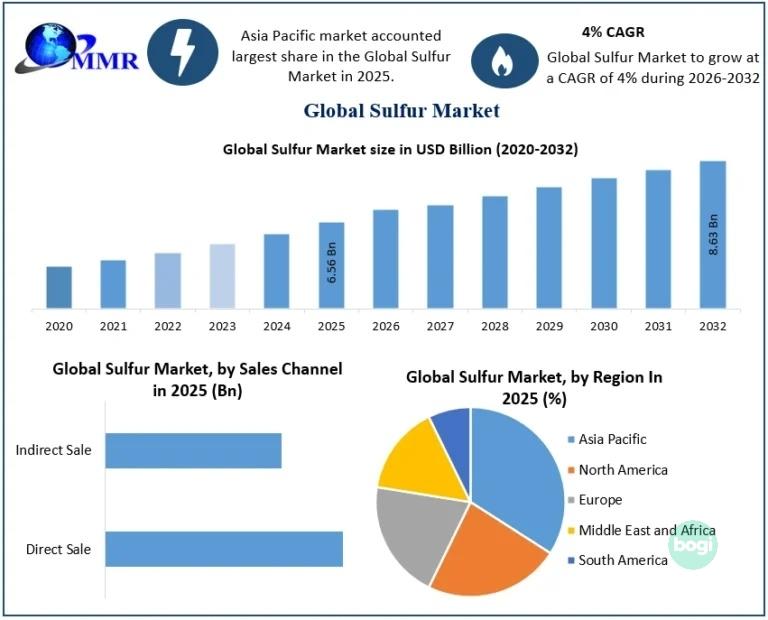
Sulfur market valued at USD 6.56 Billion in 2025.
Expected to reach nearly USD 8.63 Billion by 2032.
Forecast to grow at a CAGR of 4% through 2032.
Fertilizer production continues to support strong consumption.
Industrial applications are expanding across multiple sectors.
Sustainability initiatives are encouraging efficient sulfur utilization.
Strategic investments are strengthening supply chains.
Market Overview
The Sulfur Market continues to play a critical role in the global industrial ecosystem because sulfur serves as an essential raw material across multiple manufacturing processes. Its importance extends beyond fertilizers to include petroleum refining, chemical production, metal processing, pharmaceuticals, and industrial manufacturing.
As industries increase production while focusing on operational efficiency, demand for dependable sulfur supplies continues to rise. This shift is encouraging producers to improve production capabilities, optimize logistics, and develop stronger supply partnerships. The result is a market that is steadily evolving to support changing industrial requirements while maintaining long-term growth potential.
Why This Market Matters Now
Several industries are entering a phase where consistent access to sulfur has become increasingly valuable. Agricultural productivity remains a global priority, creating sustained demand for sulfur-based fertilizers that help improve soil quality and crop yields. At the same time, chemical manufacturers continue expanding production capacities to meet growing requirements from downstream industries.
The sulfur market also benefits from broader industrial modernization. Companies are investing in cleaner production technologies and more efficient manufacturing processes, increasing the need for reliable sulfur supplies. As businesses pursue operational resilience, procurement strategies are shifting toward long-term supplier relationships and diversified sourcing models.
Get a Sample Copy – Market Report : https://www.maximizemarketresearch.com/request-sample/26714/
Key Trends Driving Growth
One of the most significant trends influencing the sulfur market is the increasing focus on sustainable industrial operations. Manufacturers are improving resource efficiency while maximizing the value of sulfur recovered from industrial processes. This approach supports both environmental objectives and commercial performance.
Another important trend is the growing integration of sulfur across specialized chemical applications. Industrial innovation continues to create new opportunities for sulfur-based products in manufacturing, processing, and material development.
Digital supply chain management is also improving visibility across procurement and inventory planning. Companies are leveraging better forecasting and logistics coordination to reduce disruptions while ensuring continuous material availability.
Market Growth Outlook
The sulfur market is positioned for stable expansion over the coming years as industrial production continues to recover and agricultural demand remains strong. The projected CAGR of 4% reflects consistent business opportunities rather than short-term market fluctuations, allowing companies to make long-term investment decisions with greater confidence.
This growth outlook supports capital investments in production facilities, infrastructure improvements, and distribution networks. Businesses that strengthen supplier relationships and optimize procurement strategies are likely to benefit from improving market conditions while maintaining competitive operational performance.
Market Segmentation
The sulfur market serves a diverse customer base across multiple industrial sectors. Fertilizer applications continue to represent one of the most significant demand segments due to sulfur's essential role in agricultural productivity and soil nutrition.
Beyond agriculture, sulfur supports chemical manufacturing, petroleum refining, metal processing, and various industrial applications that require high-quality raw materials. This diversified demand base strengthens market stability by reducing dependence on a single end-use industry.
Different application segments also encourage product innovation as manufacturers develop solutions designed to meet evolving industrial performance standards and operational requirements.
Key Highlights
Sulfur market valued at USD 6.56 Billion in 2025.
Expected to reach nearly USD 8.63 Billion by 2032.
Forecast to grow at a CAGR of 4% through 2032.
Fertilizer production continues to support strong consumption.
Industrial applications are expanding across multiple sectors.
Sustainability initiatives are encouraging efficient sulfur utilization.
Strategic investments are strengthening supply chains.
Market Overview
The Sulfur Market continues to play a critical role in the global industrial ecosystem because sulfur serves as an essential raw material across multiple manufacturing processes. Its importance extends beyond fertilizers to include petroleum refining, chemical production, metal processing, pharmaceuticals, and industrial manufacturing.
As industries increase production while focusing on operational efficiency, demand for dependable sulfur supplies continues to rise. This shift is encouraging producers to improve production capabilities, optimize logistics, and develop stronger supply partnerships. The result is a market that is steadily evolving to support changing industrial requirements while maintaining long-term growth potential.
Why This Market Matters Now
Several industries are entering a phase where consistent access to sulfur has become increasingly valuable. Agricultural productivity remains a global priority, creating sustained demand for sulfur-based fertilizers that help improve soil quality and crop yields. At the same time, chemical manufacturers continue expanding production capacities to meet growing requirements from downstream industries.
The sulfur market also benefits from broader industrial modernization. Companies are investing in cleaner production technologies and more efficient manufacturing processes, increasing the need for reliable sulfur supplies. As businesses pursue operational resilience, procurement strategies are shifting toward long-term supplier relationships and diversified sourcing models.
Get a Sample Copy – Market Report : https://www.maximizemarketresearch.com/request-sample/26714/
Key Trends Driving Growth
One of the most significant trends influencing the sulfur market is the increasing focus on sustainable industrial operations. Manufacturers are improving resource efficiency while maximizing the value of sulfur recovered from industrial processes. This approach supports both environmental objectives and commercial performance.
Another important trend is the growing integration of sulfur across specialized chemical applications. Industrial innovation continues to create new opportunities for sulfur-based products in manufacturing, processing, and material development.
Digital supply chain management is also improving visibility across procurement and inventory planning. Companies are leveraging better forecasting and logistics coordination to reduce disruptions while ensuring continuous material availability.
Market Growth Outlook
The sulfur market is positioned for stable expansion over the coming years as industrial production continues to recover and agricultural demand remains strong. The projected CAGR of 4% reflects consistent business opportunities rather than short-term market fluctuations, allowing companies to make long-term investment decisions with greater confidence.
This growth outlook supports capital investments in production facilities, infrastructure improvements, and distribution networks. Businesses that strengthen supplier relationships and optimize procurement strategies are likely to benefit from improving market conditions while maintaining competitive operational performance.
Market Segmentation
The sulfur market serves a diverse customer base across multiple industrial sectors. Fertilizer applications continue to represent one of the most significant demand segments due to sulfur's essential role in agricultural productivity and soil nutrition.
Beyond agriculture, sulfur supports chemical manufacturing, petroleum refining, metal processing, and various industrial applications that require high-quality raw materials. This diversified demand base strengthens market stability by reducing dependence on a single end-use industry.
Different application segments also encourage product innovation as manufacturers develop solutions designed to meet evolving industrial performance standards and operational requirements.
Sulfur Market Industry Trends, Growth Opportunities and Market Analysis
Key Highlights
Sulfur market valued at USD 6.56 Billion in 2025.
Expected to reach nearly USD 8.63 Billion by 2032.
Forecast to grow at a CAGR of 4% through 2032.
Fertilizer production continues to support strong consumption.
Industrial applications are expanding across multiple sectors.
Sustainability initiatives are encouraging efficient sulfur utilization.
Strategic investments are strengthening supply chains.
Market Overview
The Sulfur Market continues to play a critical role in the global industrial ecosystem because sulfur serves as an essential raw material across multiple manufacturing processes. Its importance extends beyond fertilizers to include petroleum refining, chemical production, metal processing, pharmaceuticals, and industrial manufacturing.
As industries increase production while focusing on operational efficiency, demand for dependable sulfur supplies continues to rise. This shift is encouraging producers to improve production capabilities, optimize logistics, and develop stronger supply partnerships. The result is a market that is steadily evolving to support changing industrial requirements while maintaining long-term growth potential.
Why This Market Matters Now
Several industries are entering a phase where consistent access to sulfur has become increasingly valuable. Agricultural productivity remains a global priority, creating sustained demand for sulfur-based fertilizers that help improve soil quality and crop yields. At the same time, chemical manufacturers continue expanding production capacities to meet growing requirements from downstream industries.
The sulfur market also benefits from broader industrial modernization. Companies are investing in cleaner production technologies and more efficient manufacturing processes, increasing the need for reliable sulfur supplies. As businesses pursue operational resilience, procurement strategies are shifting toward long-term supplier relationships and diversified sourcing models.
Get a Sample Copy – Market Report : https://www.maximizemarketresearch.com/request-sample/26714/
Key Trends Driving Growth
One of the most significant trends influencing the sulfur market is the increasing focus on sustainable industrial operations. Manufacturers are improving resource efficiency while maximizing the value of sulfur recovered from industrial processes. This approach supports both environmental objectives and commercial performance.
Another important trend is the growing integration of sulfur across specialized chemical applications. Industrial innovation continues to create new opportunities for sulfur-based products in manufacturing, processing, and material development.
Digital supply chain management is also improving visibility across procurement and inventory planning. Companies are leveraging better forecasting and logistics coordination to reduce disruptions while ensuring continuous material availability.
Market Growth Outlook
The sulfur market is positioned for stable expansion over the coming years as industrial production continues to recover and agricultural demand remains strong. The projected CAGR of 4% reflects consistent business opportunities rather than short-term market fluctuations, allowing companies to make long-term investment decisions with greater confidence.
This growth outlook supports capital investments in production facilities, infrastructure improvements, and distribution networks. Businesses that strengthen supplier relationships and optimize procurement strategies are likely to benefit from improving market conditions while maintaining competitive operational performance.
Market Segmentation
The sulfur market serves a diverse customer base across multiple industrial sectors. Fertilizer applications continue to represent one of the most significant demand segments due to sulfur's essential role in agricultural productivity and soil nutrition.
Beyond agriculture, sulfur supports chemical manufacturing, petroleum refining, metal processing, and various industrial applications that require high-quality raw materials. This diversified demand base strengthens market stability by reducing dependence on a single end-use industry.
Different application segments also encourage product innovation as manufacturers develop solutions designed to meet evolving industrial performance standards and operational requirements.
0 Commentarii
0 Distribuiri
25 Views

 English
 Arabic
 French
 Spanish
 Portuguese
 Deutsch
 Turkish
 Dutch
Dutch
 Italiano
 Russian
 Portuguese (Brazil)
 Greek
Greek