


Organic Waste Market Industry Analysis and Recent Developments
Key Highlights
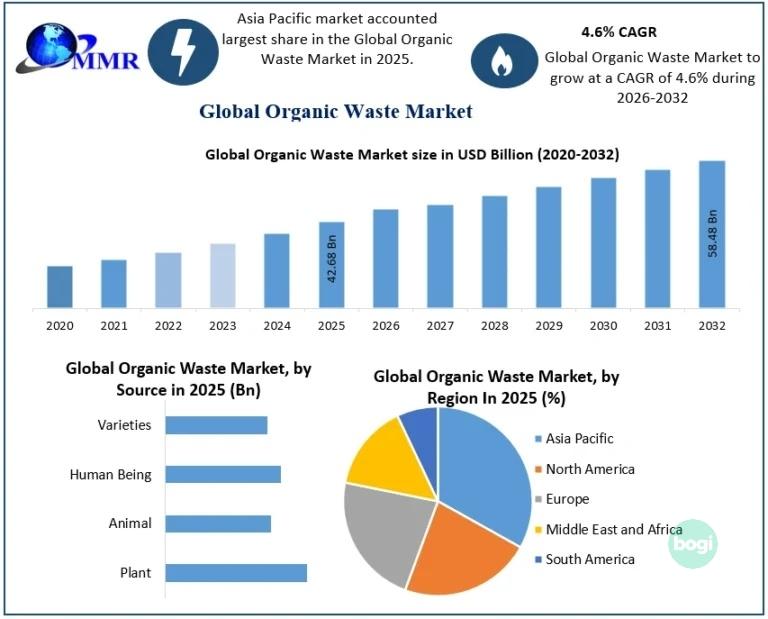
Organic Waste Market was valued at USD 42.68 Billion in 2025.
The market is projected to reach USD 58.48 Billion by 2032.
The market is expected to grow at a CAGR of 4.6% from 2025 to 2032.
Rising focus on circular economy initiatives is supporting long-term business opportunities.
Waste-to-energy and composting technologies continue to attract industrial investments.
Governments and businesses are strengthening organic waste management infrastructure.
Market Overview
Organic Waste Market is gaining strategic importance as industries face growing pressure to reduce landfill dependence and improve resource efficiency. Companies involved in manufacturing, food processing, agriculture, and municipal services are increasingly investing in advanced waste management solutions to meet sustainability targets while controlling operational costs.
The Organic Waste Market size was valued at USD 42.68 Billion in 2025 and is expected to reach USD 58.48 Billion by 2032, growing at a CAGR of 4.6% during the forecast period. This steady expansion signals long-term business opportunities for technology providers, infrastructure developers, and waste management companies seeking stable demand across industrial and municipal sectors.
Why This Market Matters Now
The shift toward sustainable resource management has transformed organic waste from an environmental challenge into a valuable economic asset. Governments are encouraging waste diversion from landfills, while businesses are adopting circular economy practices to improve operational efficiency and reduce environmental impact.
For industrial buyers and procurement leaders, the Organic Waste Market offers opportunities to recover valuable resources through compost production, renewable energy generation, and nutrient recycling. Investors also see increasing potential as environmental regulations and sustainability commitments continue to reshape waste management priorities across multiple industries.
Key Trends Driving Growth
One of the strongest trends influencing the Organic Waste Market is the rapid adoption of waste-to-energy technologies. Anaerobic digestion systems are enabling organizations to convert organic waste into biogas, creating renewable energy while reducing disposal costs.
Another important trend is the growing use of composting solutions to improve soil quality and support sustainable agriculture. Agricultural businesses are recognizing compost as a valuable alternative to conventional soil enhancement methods, creating additional demand for efficient organic waste processing systems.
Digital monitoring technologies are also improving waste collection, sorting, and processing efficiency. Better operational visibility allows organizations to optimize logistics, reduce costs, and increase recovery rates, making organic waste management more commercially attractive.
In addition, partnerships between municipalities and private waste management companies are expanding infrastructure investments, supporting broader adoption of integrated waste processing facilities.
Access a Free Sample Report Copy : https://www.maximizemarketresearch.com/request-sample/102098/
Key Highlights
Organic Waste Market was valued at USD 42.68 Billion in 2025.
The market is projected to reach USD 58.48 Billion by 2032.
The market is expected to grow at a CAGR of 4.6% from 2025 to 2032.
Rising focus on circular economy initiatives is supporting long-term business opportunities.
Waste-to-energy and composting technologies continue to attract industrial investments.
Governments and businesses are strengthening organic waste management infrastructure.
Market Overview
Organic Waste Market is gaining strategic importance as industries face growing pressure to reduce landfill dependence and improve resource efficiency. Companies involved in manufacturing, food processing, agriculture, and municipal services are increasingly investing in advanced waste management solutions to meet sustainability targets while controlling operational costs.
The Organic Waste Market size was valued at USD 42.68 Billion in 2025 and is expected to reach USD 58.48 Billion by 2032, growing at a CAGR of 4.6% during the forecast period. This steady expansion signals long-term business opportunities for technology providers, infrastructure developers, and waste management companies seeking stable demand across industrial and municipal sectors.
Why This Market Matters Now
The shift toward sustainable resource management has transformed organic waste from an environmental challenge into a valuable economic asset. Governments are encouraging waste diversion from landfills, while businesses are adopting circular economy practices to improve operational efficiency and reduce environmental impact.
For industrial buyers and procurement leaders, the Organic Waste Market offers opportunities to recover valuable resources through compost production, renewable energy generation, and nutrient recycling. Investors also see increasing potential as environmental regulations and sustainability commitments continue to reshape waste management priorities across multiple industries.
Key Trends Driving Growth
One of the strongest trends influencing the Organic Waste Market is the rapid adoption of waste-to-energy technologies. Anaerobic digestion systems are enabling organizations to convert organic waste into biogas, creating renewable energy while reducing disposal costs.
Another important trend is the growing use of composting solutions to improve soil quality and support sustainable agriculture. Agricultural businesses are recognizing compost as a valuable alternative to conventional soil enhancement methods, creating additional demand for efficient organic waste processing systems.
Digital monitoring technologies are also improving waste collection, sorting, and processing efficiency. Better operational visibility allows organizations to optimize logistics, reduce costs, and increase recovery rates, making organic waste management more commercially attractive.
In addition, partnerships between municipalities and private waste management companies are expanding infrastructure investments, supporting broader adoption of integrated waste processing facilities.
Access a Free Sample Report Copy : https://www.maximizemarketresearch.com/request-sample/102098/
Organic Waste Market Industry Analysis and Recent Developments
Key Highlights
Organic Waste Market was valued at USD 42.68 Billion in 2025.
The market is projected to reach USD 58.48 Billion by 2032.
The market is expected to grow at a CAGR of 4.6% from 2025 to 2032.
Rising focus on circular economy initiatives is supporting long-term business opportunities.
Waste-to-energy and composting technologies continue to attract industrial investments.
Governments and businesses are strengthening organic waste management infrastructure.
Market Overview
Organic Waste Market is gaining strategic importance as industries face growing pressure to reduce landfill dependence and improve resource efficiency. Companies involved in manufacturing, food processing, agriculture, and municipal services are increasingly investing in advanced waste management solutions to meet sustainability targets while controlling operational costs.
The Organic Waste Market size was valued at USD 42.68 Billion in 2025 and is expected to reach USD 58.48 Billion by 2032, growing at a CAGR of 4.6% during the forecast period. This steady expansion signals long-term business opportunities for technology providers, infrastructure developers, and waste management companies seeking stable demand across industrial and municipal sectors.
Why This Market Matters Now
The shift toward sustainable resource management has transformed organic waste from an environmental challenge into a valuable economic asset. Governments are encouraging waste diversion from landfills, while businesses are adopting circular economy practices to improve operational efficiency and reduce environmental impact.
For industrial buyers and procurement leaders, the Organic Waste Market offers opportunities to recover valuable resources through compost production, renewable energy generation, and nutrient recycling. Investors also see increasing potential as environmental regulations and sustainability commitments continue to reshape waste management priorities across multiple industries.
Key Trends Driving Growth
One of the strongest trends influencing the Organic Waste Market is the rapid adoption of waste-to-energy technologies. Anaerobic digestion systems are enabling organizations to convert organic waste into biogas, creating renewable energy while reducing disposal costs.
Another important trend is the growing use of composting solutions to improve soil quality and support sustainable agriculture. Agricultural businesses are recognizing compost as a valuable alternative to conventional soil enhancement methods, creating additional demand for efficient organic waste processing systems.
Digital monitoring technologies are also improving waste collection, sorting, and processing efficiency. Better operational visibility allows organizations to optimize logistics, reduce costs, and increase recovery rates, making organic waste management more commercially attractive.
In addition, partnerships between municipalities and private waste management companies are expanding infrastructure investments, supporting broader adoption of integrated waste processing facilities.
Access a Free Sample Report Copy : https://www.maximizemarketresearch.com/request-sample/102098/
0 Commentarii
0 Distribuiri
446 Views

 English
 Arabic
 French
 Spanish
 Portuguese
 Deutsch
 Turkish
 Dutch
Dutch
 Italiano
 Russian
 Portuguese (Brazil)
 Greek
Greek