


Microfinance Market Share, Growth Analysis, and Emerging Business Opportunities
Key Highlights
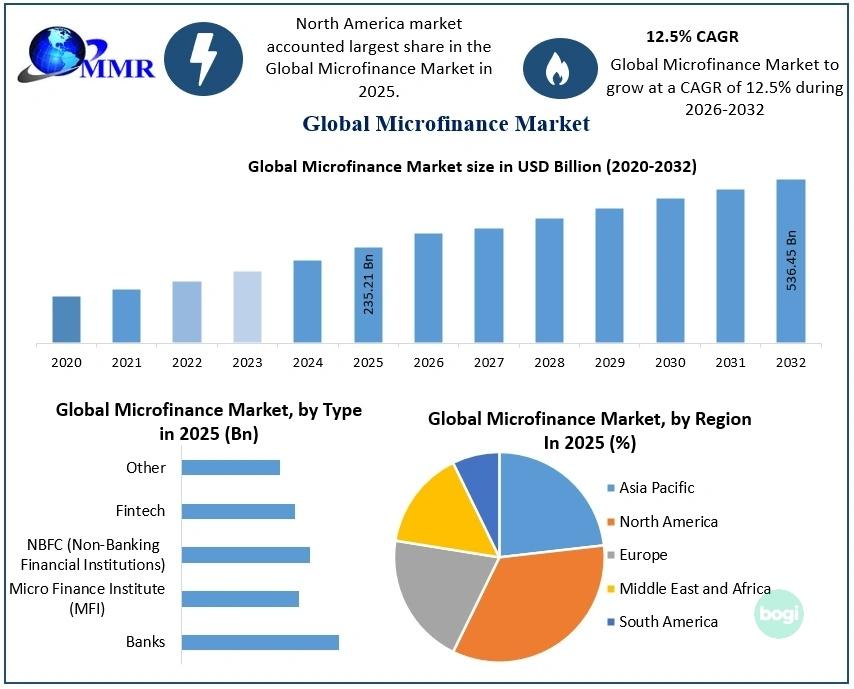
The Microfinance Market was valued at USD 235.21 Billion in 2025.
The market is projected to reach nearly USD 536.45 Billion by 2032.
The market is expected to grow at a CAGR of 12.5% from 2025 to 2032.
Digital financial services are transforming customer access and operational efficiency.
Rural entrepreneurs and small businesses continue to create new lending opportunities.
Fintech partnerships are improving loan distribution and repayment management.
Market Overview
The Microfinance Market is experiencing significant expansion as financial institutions focus on delivering credit, savings, insurance, and payment services to individuals and businesses that have traditionally remained outside the formal banking system. The market was valued at USD 235.21 Billion in 2025 and is expected to reach nearly USD 536.45 Billion by 2032, growing at a CAGR of 12.5% during the forecast period. This growth signals stronger investment opportunities while encouraging lenders to expand their customer base through inclusive financial products.
Growing digital connectivity has made financial services more accessible across rural and semi-urban regions. As more consumers gain access to smartphones and digital payment platforms, microfinance providers are improving operational efficiency while reducing service delivery costs. This transition is creating a stronger business environment for lenders seeking sustainable portfolio growth.
Why This Market Matters Now
The Microfinance Market has become increasingly important because financial inclusion is now viewed as an essential component of economic development rather than a social initiative alone. Governments, regulators, and financial institutions are introducing programs that encourage lending to underserved communities, creating a supportive environment for market expansion.
Small enterprises continue to require affordable financing to improve productivity, create employment, and strengthen local economies. At the same time, financial technology is reducing barriers that previously limited customer access to formal financial services. These combined developments are helping institutions reach new borrowers while improving credit assessment and repayment monitoring.
Key Trends Driving Growth
Digital transformation remains one of the strongest growth drivers in the Microfinance Market. Mobile applications, digital identity verification, and online loan processing are simplifying customer onboarding while reducing operational expenses. This enables institutions to serve larger customer bases with greater efficiency.
Another important trend is the increasing collaboration between fintech companies and traditional microfinance institutions. These partnerships improve digital payment capabilities, automate lending operations, and strengthen customer engagement through personalized financial services.
Women entrepreneurs and rural businesses continue to emerge as key customer segments. Financial institutions are developing specialized loan products that support entrepreneurship, agriculture, and small-scale manufacturing. This diversified lending approach is expanding revenue opportunities while supporting broader economic participation.
Receive a Free Sample Copy Instantly : https://www.maximizemarketresearch.com/request-sample/230628/
Key Highlights
The Microfinance Market was valued at USD 235.21 Billion in 2025.
The market is projected to reach nearly USD 536.45 Billion by 2032.
The market is expected to grow at a CAGR of 12.5% from 2025 to 2032.
Digital financial services are transforming customer access and operational efficiency.
Rural entrepreneurs and small businesses continue to create new lending opportunities.
Fintech partnerships are improving loan distribution and repayment management.
Market Overview
The Microfinance Market is experiencing significant expansion as financial institutions focus on delivering credit, savings, insurance, and payment services to individuals and businesses that have traditionally remained outside the formal banking system. The market was valued at USD 235.21 Billion in 2025 and is expected to reach nearly USD 536.45 Billion by 2032, growing at a CAGR of 12.5% during the forecast period. This growth signals stronger investment opportunities while encouraging lenders to expand their customer base through inclusive financial products.
Growing digital connectivity has made financial services more accessible across rural and semi-urban regions. As more consumers gain access to smartphones and digital payment platforms, microfinance providers are improving operational efficiency while reducing service delivery costs. This transition is creating a stronger business environment for lenders seeking sustainable portfolio growth.
Why This Market Matters Now
The Microfinance Market has become increasingly important because financial inclusion is now viewed as an essential component of economic development rather than a social initiative alone. Governments, regulators, and financial institutions are introducing programs that encourage lending to underserved communities, creating a supportive environment for market expansion.
Small enterprises continue to require affordable financing to improve productivity, create employment, and strengthen local economies. At the same time, financial technology is reducing barriers that previously limited customer access to formal financial services. These combined developments are helping institutions reach new borrowers while improving credit assessment and repayment monitoring.
Key Trends Driving Growth
Digital transformation remains one of the strongest growth drivers in the Microfinance Market. Mobile applications, digital identity verification, and online loan processing are simplifying customer onboarding while reducing operational expenses. This enables institutions to serve larger customer bases with greater efficiency.
Another important trend is the increasing collaboration between fintech companies and traditional microfinance institutions. These partnerships improve digital payment capabilities, automate lending operations, and strengthen customer engagement through personalized financial services.
Women entrepreneurs and rural businesses continue to emerge as key customer segments. Financial institutions are developing specialized loan products that support entrepreneurship, agriculture, and small-scale manufacturing. This diversified lending approach is expanding revenue opportunities while supporting broader economic participation.
Receive a Free Sample Copy Instantly : https://www.maximizemarketresearch.com/request-sample/230628/
Microfinance Market Share, Growth Analysis, and Emerging Business Opportunities
Key Highlights
The Microfinance Market was valued at USD 235.21 Billion in 2025.
The market is projected to reach nearly USD 536.45 Billion by 2032.
The market is expected to grow at a CAGR of 12.5% from 2025 to 2032.
Digital financial services are transforming customer access and operational efficiency.
Rural entrepreneurs and small businesses continue to create new lending opportunities.
Fintech partnerships are improving loan distribution and repayment management.
Market Overview
The Microfinance Market is experiencing significant expansion as financial institutions focus on delivering credit, savings, insurance, and payment services to individuals and businesses that have traditionally remained outside the formal banking system. The market was valued at USD 235.21 Billion in 2025 and is expected to reach nearly USD 536.45 Billion by 2032, growing at a CAGR of 12.5% during the forecast period. This growth signals stronger investment opportunities while encouraging lenders to expand their customer base through inclusive financial products.
Growing digital connectivity has made financial services more accessible across rural and semi-urban regions. As more consumers gain access to smartphones and digital payment platforms, microfinance providers are improving operational efficiency while reducing service delivery costs. This transition is creating a stronger business environment for lenders seeking sustainable portfolio growth.
Why This Market Matters Now
The Microfinance Market has become increasingly important because financial inclusion is now viewed as an essential component of economic development rather than a social initiative alone. Governments, regulators, and financial institutions are introducing programs that encourage lending to underserved communities, creating a supportive environment for market expansion.
Small enterprises continue to require affordable financing to improve productivity, create employment, and strengthen local economies. At the same time, financial technology is reducing barriers that previously limited customer access to formal financial services. These combined developments are helping institutions reach new borrowers while improving credit assessment and repayment monitoring.
Key Trends Driving Growth
Digital transformation remains one of the strongest growth drivers in the Microfinance Market. Mobile applications, digital identity verification, and online loan processing are simplifying customer onboarding while reducing operational expenses. This enables institutions to serve larger customer bases with greater efficiency.
Another important trend is the increasing collaboration between fintech companies and traditional microfinance institutions. These partnerships improve digital payment capabilities, automate lending operations, and strengthen customer engagement through personalized financial services.
Women entrepreneurs and rural businesses continue to emerge as key customer segments. Financial institutions are developing specialized loan products that support entrepreneurship, agriculture, and small-scale manufacturing. This diversified lending approach is expanding revenue opportunities while supporting broader economic participation.
Receive a Free Sample Copy Instantly : https://www.maximizemarketresearch.com/request-sample/230628/
0 التعليقات
0 المشاركات
669 مشاهدة

 English
 French
 Spanish
 Portuguese
 Deutsch
 Turkish
 Dutch
Dutch
 Italiano
 Russian
 Romaian
 Portuguese (Brazil)
 Greek
Greek