


Purified Terephthalic Acid (PTA) Market Top Companies and Industry Insights
Key Highlights
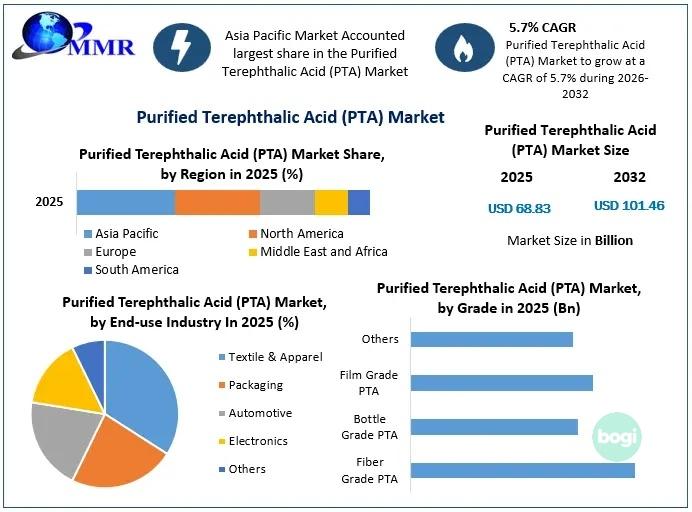
Purified Terephthalic Acid (PTA) Market valued at USD 68.83 Billion in 2025
Expected to reach nearly USD 101.46 Billion by 2032
Expanding at a CAGR of 5.7 % during 2026–2032
Strong demand driven by polyester fiber and PET packaging expansion
Increasing industrial reliance on high-volume petrochemical intermediates
Asia Pacific continues to dominate global consumption patterns
Packaging and textile industries remain core demand generators
Market Overview
Global industrial buyers are witnessing a tightening supply-demand balance in polyester feedstock chains, pushing chemical manufacturers to reassess production efficiency and raw material sourcing strategies. At the center of this shift, the Purified Terephthalic Acid (PTA) Market is emerging as a critical enabler of polyester-based value chains, directly influencing textiles, packaging, and engineering plastics production.
The Purified Terephthalic Acid (PTA) Market was valued at USD 68.83 Billion in 2025, signaling strong baseline demand across downstream industries. This scale reflects the material’s deep integration into global manufacturing ecosystems, where even minor supply disruptions can ripple across apparel, beverage packaging, and industrial fiber segments. As procurement leaders prioritize cost stability and feedstock security, PTA is becoming strategically indispensable.
Why This Market Matters Now
The current transformation in global manufacturing is being shaped by rising consumer demand for lightweight packaging, fast fashion cycles, and scalable synthetic fiber production. This has intensified pressure on petrochemical suppliers to ensure consistent PTA availability. The Purified Terephthalic Acid (PTA) Market is therefore no longer just a commodity segment—it is a strategic input layer supporting multi-billion-dollar downstream industries.
With growing dependence on PET-based packaging in food and beverage sectors, procurement teams are increasingly locking long-term contracts to reduce exposure to raw material volatility. This shift benefits large-scale PTA producers while creating entry barriers for smaller manufacturers. As a result, supply chain consolidation is accelerating across the value chain.
Key Trends Driving Growth
One of the most influential trends shaping the Purified Terephthalic Acid (PTA) Market is the rising integration of polyester in sustainable textile production. Manufacturers are optimizing PTA utilization to support blended fabrics and recycled polyester outputs, improving resource efficiency without compromising scale.
Another key trend is the rapid expansion of PET packaging applications, especially in bottled beverages and consumer goods. This structural demand shift is reinforcing long-term consumption stability for PTA producers. Additionally, petrochemical companies are investing in capacity expansion projects to address tightening regional supply gaps.
Digitalization in chemical manufacturing is also improving process efficiency, enabling producers to reduce energy consumption and optimize yield rates. These advancements are strengthening competitiveness in the Purified Terephthalic Acid (PTA) Market while supporting long-term margin stability.
Request a Free Preview of the Market Report : https://www.maximizemarketresearch.com/request-sample/29017/
Key Highlights
Purified Terephthalic Acid (PTA) Market valued at USD 68.83 Billion in 2025
Expected to reach nearly USD 101.46 Billion by 2032
Expanding at a CAGR of 5.7 % during 2026–2032
Strong demand driven by polyester fiber and PET packaging expansion
Increasing industrial reliance on high-volume petrochemical intermediates
Asia Pacific continues to dominate global consumption patterns
Packaging and textile industries remain core demand generators
Market Overview
Global industrial buyers are witnessing a tightening supply-demand balance in polyester feedstock chains, pushing chemical manufacturers to reassess production efficiency and raw material sourcing strategies. At the center of this shift, the Purified Terephthalic Acid (PTA) Market is emerging as a critical enabler of polyester-based value chains, directly influencing textiles, packaging, and engineering plastics production.
The Purified Terephthalic Acid (PTA) Market was valued at USD 68.83 Billion in 2025, signaling strong baseline demand across downstream industries. This scale reflects the material’s deep integration into global manufacturing ecosystems, where even minor supply disruptions can ripple across apparel, beverage packaging, and industrial fiber segments. As procurement leaders prioritize cost stability and feedstock security, PTA is becoming strategically indispensable.
Why This Market Matters Now
The current transformation in global manufacturing is being shaped by rising consumer demand for lightweight packaging, fast fashion cycles, and scalable synthetic fiber production. This has intensified pressure on petrochemical suppliers to ensure consistent PTA availability. The Purified Terephthalic Acid (PTA) Market is therefore no longer just a commodity segment—it is a strategic input layer supporting multi-billion-dollar downstream industries.
With growing dependence on PET-based packaging in food and beverage sectors, procurement teams are increasingly locking long-term contracts to reduce exposure to raw material volatility. This shift benefits large-scale PTA producers while creating entry barriers for smaller manufacturers. As a result, supply chain consolidation is accelerating across the value chain.
Key Trends Driving Growth
One of the most influential trends shaping the Purified Terephthalic Acid (PTA) Market is the rising integration of polyester in sustainable textile production. Manufacturers are optimizing PTA utilization to support blended fabrics and recycled polyester outputs, improving resource efficiency without compromising scale.
Another key trend is the rapid expansion of PET packaging applications, especially in bottled beverages and consumer goods. This structural demand shift is reinforcing long-term consumption stability for PTA producers. Additionally, petrochemical companies are investing in capacity expansion projects to address tightening regional supply gaps.
Digitalization in chemical manufacturing is also improving process efficiency, enabling producers to reduce energy consumption and optimize yield rates. These advancements are strengthening competitiveness in the Purified Terephthalic Acid (PTA) Market while supporting long-term margin stability.
Request a Free Preview of the Market Report : https://www.maximizemarketresearch.com/request-sample/29017/
Purified Terephthalic Acid (PTA) Market Top Companies and Industry Insights
Key Highlights
Purified Terephthalic Acid (PTA) Market valued at USD 68.83 Billion in 2025
Expected to reach nearly USD 101.46 Billion by 2032
Expanding at a CAGR of 5.7 % during 2026–2032
Strong demand driven by polyester fiber and PET packaging expansion
Increasing industrial reliance on high-volume petrochemical intermediates
Asia Pacific continues to dominate global consumption patterns
Packaging and textile industries remain core demand generators
Market Overview
Global industrial buyers are witnessing a tightening supply-demand balance in polyester feedstock chains, pushing chemical manufacturers to reassess production efficiency and raw material sourcing strategies. At the center of this shift, the Purified Terephthalic Acid (PTA) Market is emerging as a critical enabler of polyester-based value chains, directly influencing textiles, packaging, and engineering plastics production.
The Purified Terephthalic Acid (PTA) Market was valued at USD 68.83 Billion in 2025, signaling strong baseline demand across downstream industries. This scale reflects the material’s deep integration into global manufacturing ecosystems, where even minor supply disruptions can ripple across apparel, beverage packaging, and industrial fiber segments. As procurement leaders prioritize cost stability and feedstock security, PTA is becoming strategically indispensable.
Why This Market Matters Now
The current transformation in global manufacturing is being shaped by rising consumer demand for lightweight packaging, fast fashion cycles, and scalable synthetic fiber production. This has intensified pressure on petrochemical suppliers to ensure consistent PTA availability. The Purified Terephthalic Acid (PTA) Market is therefore no longer just a commodity segment—it is a strategic input layer supporting multi-billion-dollar downstream industries.
With growing dependence on PET-based packaging in food and beverage sectors, procurement teams are increasingly locking long-term contracts to reduce exposure to raw material volatility. This shift benefits large-scale PTA producers while creating entry barriers for smaller manufacturers. As a result, supply chain consolidation is accelerating across the value chain.
Key Trends Driving Growth
One of the most influential trends shaping the Purified Terephthalic Acid (PTA) Market is the rising integration of polyester in sustainable textile production. Manufacturers are optimizing PTA utilization to support blended fabrics and recycled polyester outputs, improving resource efficiency without compromising scale.
Another key trend is the rapid expansion of PET packaging applications, especially in bottled beverages and consumer goods. This structural demand shift is reinforcing long-term consumption stability for PTA producers. Additionally, petrochemical companies are investing in capacity expansion projects to address tightening regional supply gaps.
Digitalization in chemical manufacturing is also improving process efficiency, enabling producers to reduce energy consumption and optimize yield rates. These advancements are strengthening competitiveness in the Purified Terephthalic Acid (PTA) Market while supporting long-term margin stability.
Request a Free Preview of the Market Report : https://www.maximizemarketresearch.com/request-sample/29017/
0 Comments
0 Shares
1176 Views

 Arabic
 French
 Spanish
 Portuguese
 Deutsch
 Turkish
 Dutch
Dutch
 Italiano
 Russian
 Romaian
 Portuguese (Brazil)
 Greek
Greek