


Electronic Nose Market Trends, Future Growth Potential, and Strategic Industry Outlook
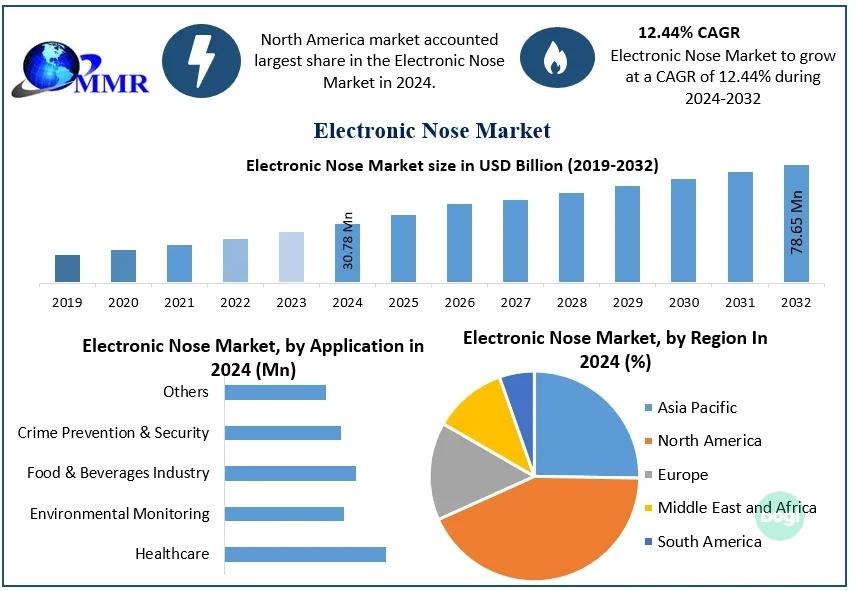
The Electronic Nose Market size was valued at USD 30.78 Billion in 2024 and the total Electronic Nose revenue is expected to grow at a CAGR of 12.44% from 2025 to 2032, reaching nearly USD 78.65 Billion. AI-Driven Next-Generation Sensing Technologies Create Billion-Dollar Opportunity
The global Electronic Nose Market is entering a new phase of rapid technological evolution as artificial intelligence, advanced sensor technologies, and digital transformation reshape industrial quality control, healthcare diagnostics, environmental monitoring, and security applications worldwide. According to Maximize Market Research, the Electronic Nose Market was valued at USD 30.78 Billion in 2024 and is projected to reach nearly USD 78.65 Billion by 2032, expanding at a CAGR of 12.44% during the forecast period from 2025 to 2032.
Growing investments in smart sensing technologies, predictive analytics, machine learning-enabled odor recognition systems, and Industry 4.0 initiatives are creating substantial growth opportunities for electronic nose manufacturers and technology providers. Organizations across healthcare, food safety, environmental compliance, and industrial automation are increasingly adopting electronic nose solutions to improve operational efficiency, reduce testing time, and enhance decision-making accuracy.
Get Instant Access to a Free Market Research Sample : https://www.maximizemarketresearch.com/request-sample/62756/
AI-Driven Innovation Reshaping the Future of Electronic Nose Technology
Electronic nose systems are rapidly evolving beyond traditional odor detection capabilities. Modern platforms increasingly integrate artificial intelligence, cloud connectivity, machine learning algorithms, and advanced pattern-recognition software to deliver real-time analysis and predictive insights.
As enterprises pursue digital transformation initiatives, electronic nose technologies are becoming valuable tools for:
Automated quality assurance
Predictive maintenance programs
Food freshness monitoring
Medical diagnostics support
Environmental pollution detection
Security and threat identification
Industrial process optimization
The convergence of AI-powered analytics with sensor technologies is enabling organizations to transform large volumes of sensory data into actionable business intelligence, strengthening the market's long-term growth outlook.
Investment Momentum Strengthens Across Multiple Industries
Increasing demand for rapid, non-invasive, and highly accurate detection systems is encouraging investments across public and private sectors. Companies are focusing on product innovation, sensor miniaturization, software integration, and advanced data analytics capabilities.
Industry participants are actively pursuing:
Strategic technology partnerships
AI-driven product development
Sensor performance enhancements
Research and development investments
Manufacturing expansion initiatives
Healthcare application commercialization
Smart environmental monitoring programs
The growing adoption of automation technologies and smart manufacturing practices is expected to further strengthen investment activity throughout the forecast period.
The Electronic Nose Market size was valued at USD 30.78 Billion in 2024 and the total Electronic Nose revenue is expected to grow at a CAGR of 12.44% from 2025 to 2032, reaching nearly USD 78.65 Billion. AI-Driven Next-Generation Sensing Technologies Create Billion-Dollar Opportunity
The global Electronic Nose Market is entering a new phase of rapid technological evolution as artificial intelligence, advanced sensor technologies, and digital transformation reshape industrial quality control, healthcare diagnostics, environmental monitoring, and security applications worldwide. According to Maximize Market Research, the Electronic Nose Market was valued at USD 30.78 Billion in 2024 and is projected to reach nearly USD 78.65 Billion by 2032, expanding at a CAGR of 12.44% during the forecast period from 2025 to 2032.
Growing investments in smart sensing technologies, predictive analytics, machine learning-enabled odor recognition systems, and Industry 4.0 initiatives are creating substantial growth opportunities for electronic nose manufacturers and technology providers. Organizations across healthcare, food safety, environmental compliance, and industrial automation are increasingly adopting electronic nose solutions to improve operational efficiency, reduce testing time, and enhance decision-making accuracy.
Get Instant Access to a Free Market Research Sample : https://www.maximizemarketresearch.com/request-sample/62756/
AI-Driven Innovation Reshaping the Future of Electronic Nose Technology
Electronic nose systems are rapidly evolving beyond traditional odor detection capabilities. Modern platforms increasingly integrate artificial intelligence, cloud connectivity, machine learning algorithms, and advanced pattern-recognition software to deliver real-time analysis and predictive insights.
As enterprises pursue digital transformation initiatives, electronic nose technologies are becoming valuable tools for:
Automated quality assurance
Predictive maintenance programs
Food freshness monitoring
Medical diagnostics support
Environmental pollution detection
Security and threat identification
Industrial process optimization
The convergence of AI-powered analytics with sensor technologies is enabling organizations to transform large volumes of sensory data into actionable business intelligence, strengthening the market's long-term growth outlook.
Investment Momentum Strengthens Across Multiple Industries
Increasing demand for rapid, non-invasive, and highly accurate detection systems is encouraging investments across public and private sectors. Companies are focusing on product innovation, sensor miniaturization, software integration, and advanced data analytics capabilities.
Industry participants are actively pursuing:
Strategic technology partnerships
AI-driven product development
Sensor performance enhancements
Research and development investments
Manufacturing expansion initiatives
Healthcare application commercialization
Smart environmental monitoring programs
The growing adoption of automation technologies and smart manufacturing practices is expected to further strengthen investment activity throughout the forecast period.
Electronic Nose Market Trends, Future Growth Potential, and Strategic Industry Outlook
The Electronic Nose Market size was valued at USD 30.78 Billion in 2024 and the total Electronic Nose revenue is expected to grow at a CAGR of 12.44% from 2025 to 2032, reaching nearly USD 78.65 Billion. AI-Driven Next-Generation Sensing Technologies Create Billion-Dollar Opportunity
The global Electronic Nose Market is entering a new phase of rapid technological evolution as artificial intelligence, advanced sensor technologies, and digital transformation reshape industrial quality control, healthcare diagnostics, environmental monitoring, and security applications worldwide. According to Maximize Market Research, the Electronic Nose Market was valued at USD 30.78 Billion in 2024 and is projected to reach nearly USD 78.65 Billion by 2032, expanding at a CAGR of 12.44% during the forecast period from 2025 to 2032.
Growing investments in smart sensing technologies, predictive analytics, machine learning-enabled odor recognition systems, and Industry 4.0 initiatives are creating substantial growth opportunities for electronic nose manufacturers and technology providers. Organizations across healthcare, food safety, environmental compliance, and industrial automation are increasingly adopting electronic nose solutions to improve operational efficiency, reduce testing time, and enhance decision-making accuracy.
Get Instant Access to a Free Market Research Sample : https://www.maximizemarketresearch.com/request-sample/62756/
AI-Driven Innovation Reshaping the Future of Electronic Nose Technology
Electronic nose systems are rapidly evolving beyond traditional odor detection capabilities. Modern platforms increasingly integrate artificial intelligence, cloud connectivity, machine learning algorithms, and advanced pattern-recognition software to deliver real-time analysis and predictive insights.
As enterprises pursue digital transformation initiatives, electronic nose technologies are becoming valuable tools for:
Automated quality assurance
Predictive maintenance programs
Food freshness monitoring
Medical diagnostics support
Environmental pollution detection
Security and threat identification
Industrial process optimization
The convergence of AI-powered analytics with sensor technologies is enabling organizations to transform large volumes of sensory data into actionable business intelligence, strengthening the market's long-term growth outlook.
Investment Momentum Strengthens Across Multiple Industries
Increasing demand for rapid, non-invasive, and highly accurate detection systems is encouraging investments across public and private sectors. Companies are focusing on product innovation, sensor miniaturization, software integration, and advanced data analytics capabilities.
Industry participants are actively pursuing:
Strategic technology partnerships
AI-driven product development
Sensor performance enhancements
Research and development investments
Manufacturing expansion initiatives
Healthcare application commercialization
Smart environmental monitoring programs
The growing adoption of automation technologies and smart manufacturing practices is expected to further strengthen investment activity throughout the forecast period.
0 Σχόλια
0 Μοιράστηκε
958 Views

 English
 Arabic
 French
 Spanish
 Portuguese
 Deutsch
 Turkish
 Dutch
Dutch
 Italiano
 Russian
 Romaian
 Portuguese (Brazil)