


Critical Communication Market Industry Outlook Share Trends and Strategic Growth Drivers
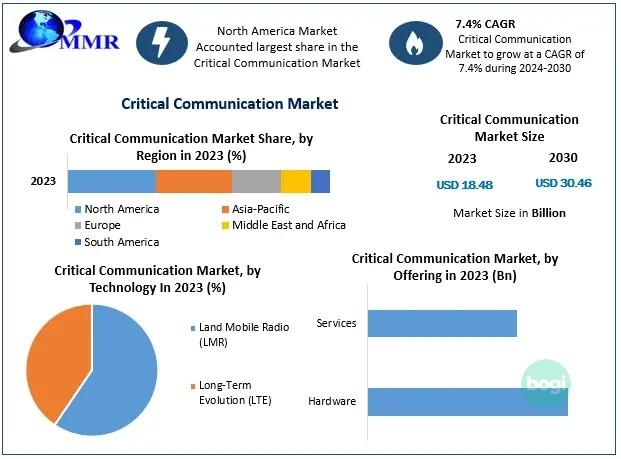
The Critical Communication Market Size was valued at USD 18.48 Billion in 2023 and is projected to reach nearly USD 30.46 Billion by 2030, expanding at a CAGR of 7.4% during the forecast period (2024–2030), according to Maximize Market Research (MMR).
The global Critical Communication Market is entering a transformative growth phase as governments, defense agencies, transportation operators, utilities, and industrial enterprises accelerate investments in secure, resilient, and mission-critical communication infrastructure. The increasing need to modernize legacy communication systems, combined with the adoption of AI-enabled technologies, LTE networks, and digital command-and-control platforms, is creating substantial opportunities across global markets.
Request a Sample of the Full Market Report : https://www.maximizemarketresearch.com/request-sample/36320/
Digital Transformation and AI Integration Reshaping Critical Communications
The future of critical communication is increasingly defined by digital transformation. Organizations responsible for emergency response, public safety, transportation, mining, and utility operations are shifting from traditional communication systems toward broadband-enabled and intelligent communication platforms.
Artificial intelligence is emerging as a strategic enabler across mission-critical operations. AI-powered analytics, predictive monitoring, automated incident management, and real-time situational awareness solutions are helping organizations improve response times and operational efficiency.
The convergence of AI, cloud computing, IoT-enabled devices, and advanced LTE communication technologies is driving the next generation of critical communication ecosystems.
Investment Momentum Accelerates Across Mission-Critical Industries
Growing public safety concerns, increasing disaster management requirements, and the need for uninterrupted communication during emergencies are driving significant investment activity worldwide.
Governments and enterprises are expanding communication infrastructure to support:
Emergency response systems
Public safety operations
Transportation networks
Utility management
Mining operations
Industrial safety applications
Defense communication systems
The increasing modernization of aging communication equipment remains one of the primary growth drivers for the Critical Communication Market.
Market Segmentation Highlights
By Offering
Hardware
Services
The hardware segment continues to hold a significant market share due to growing deployment of advanced communication devices, network equipment, and broadband communication infrastructure.
By Technology
Land Mobile Radio (LMR)
Long-Term Evolution (LTE)
LTE-based solutions are witnessing strong adoption as organizations demand high-speed data transmission, enhanced interoperability, video communications, and real-time operational intelligence.
By End-Use Vertical
Public Safety
Transportation
Utilities
Mining
Others
Public safety remains one of the most influential end-use sectors, supported by rising government investments in emergency response modernization.
Curious about the market dynamics? Get a free sample to explore the latest insights here
Critical Communication Market, Key Players are:
1. Ascom (Holding) AG
2. AT&T, Inc.
3. Cobham Wireless
4. Ericsson AB
5. Harris Corporation
6. Huawei Technologies Co. Ltd.
7. Hytera Communications Corporation Ltd.
8. Inmarsat plc
9. Leonardo Company, S.p.A
10.Mentura Group Oy
11.Motorola Mobility LLC
12.Nokia Corporation
13.Telstra Corporation Ltd.
14.Zenitel Group
15.ZTE Corporation
Recent Industry Developments Strengthening Market Growth
Leading market participants are focusing on innovation, partnerships, and next-generation communication technologies to strengthen their competitive positions.
Recent strategic developments across the industry include:
Expansion of mission-critical LTE networks
Integration of AI-enabled communication platforms
Development of broadband public safety communication systems
Investments in cloud-based command-and-control solutions
Enhanced cybersecurity capabilities for mission-critical networks
Deployment of intelligent emergency response technologies
The Critical Communication Market Size was valued at USD 18.48 Billion in 2023 and is projected to reach nearly USD 30.46 Billion by 2030, expanding at a CAGR of 7.4% during the forecast period (2024–2030), according to Maximize Market Research (MMR).
The global Critical Communication Market is entering a transformative growth phase as governments, defense agencies, transportation operators, utilities, and industrial enterprises accelerate investments in secure, resilient, and mission-critical communication infrastructure. The increasing need to modernize legacy communication systems, combined with the adoption of AI-enabled technologies, LTE networks, and digital command-and-control platforms, is creating substantial opportunities across global markets.
Request a Sample of the Full Market Report : https://www.maximizemarketresearch.com/request-sample/36320/
Digital Transformation and AI Integration Reshaping Critical Communications
The future of critical communication is increasingly defined by digital transformation. Organizations responsible for emergency response, public safety, transportation, mining, and utility operations are shifting from traditional communication systems toward broadband-enabled and intelligent communication platforms.
Artificial intelligence is emerging as a strategic enabler across mission-critical operations. AI-powered analytics, predictive monitoring, automated incident management, and real-time situational awareness solutions are helping organizations improve response times and operational efficiency.
The convergence of AI, cloud computing, IoT-enabled devices, and advanced LTE communication technologies is driving the next generation of critical communication ecosystems.
Investment Momentum Accelerates Across Mission-Critical Industries
Growing public safety concerns, increasing disaster management requirements, and the need for uninterrupted communication during emergencies are driving significant investment activity worldwide.
Governments and enterprises are expanding communication infrastructure to support:
Emergency response systems
Public safety operations
Transportation networks
Utility management
Mining operations
Industrial safety applications
Defense communication systems
The increasing modernization of aging communication equipment remains one of the primary growth drivers for the Critical Communication Market.
Market Segmentation Highlights
By Offering
Hardware
Services
The hardware segment continues to hold a significant market share due to growing deployment of advanced communication devices, network equipment, and broadband communication infrastructure.
By Technology
Land Mobile Radio (LMR)
Long-Term Evolution (LTE)
LTE-based solutions are witnessing strong adoption as organizations demand high-speed data transmission, enhanced interoperability, video communications, and real-time operational intelligence.
By End-Use Vertical
Public Safety
Transportation
Utilities
Mining
Others
Public safety remains one of the most influential end-use sectors, supported by rising government investments in emergency response modernization.
Curious about the market dynamics? Get a free sample to explore the latest insights here
Critical Communication Market, Key Players are:
1. Ascom (Holding) AG
2. AT&T, Inc.
3. Cobham Wireless
4. Ericsson AB
5. Harris Corporation
6. Huawei Technologies Co. Ltd.
7. Hytera Communications Corporation Ltd.
8. Inmarsat plc
9. Leonardo Company, S.p.A
10.Mentura Group Oy
11.Motorola Mobility LLC
12.Nokia Corporation
13.Telstra Corporation Ltd.
14.Zenitel Group
15.ZTE Corporation
Recent Industry Developments Strengthening Market Growth
Leading market participants are focusing on innovation, partnerships, and next-generation communication technologies to strengthen their competitive positions.
Recent strategic developments across the industry include:
Expansion of mission-critical LTE networks
Integration of AI-enabled communication platforms
Development of broadband public safety communication systems
Investments in cloud-based command-and-control solutions
Enhanced cybersecurity capabilities for mission-critical networks
Deployment of intelligent emergency response technologies
Critical Communication Market Industry Outlook Share Trends and Strategic Growth Drivers
The Critical Communication Market Size was valued at USD 18.48 Billion in 2023 and is projected to reach nearly USD 30.46 Billion by 2030, expanding at a CAGR of 7.4% during the forecast period (2024–2030), according to Maximize Market Research (MMR).
The global Critical Communication Market is entering a transformative growth phase as governments, defense agencies, transportation operators, utilities, and industrial enterprises accelerate investments in secure, resilient, and mission-critical communication infrastructure. The increasing need to modernize legacy communication systems, combined with the adoption of AI-enabled technologies, LTE networks, and digital command-and-control platforms, is creating substantial opportunities across global markets.
Request a Sample of the Full Market Report : https://www.maximizemarketresearch.com/request-sample/36320/
Digital Transformation and AI Integration Reshaping Critical Communications
The future of critical communication is increasingly defined by digital transformation. Organizations responsible for emergency response, public safety, transportation, mining, and utility operations are shifting from traditional communication systems toward broadband-enabled and intelligent communication platforms.
Artificial intelligence is emerging as a strategic enabler across mission-critical operations. AI-powered analytics, predictive monitoring, automated incident management, and real-time situational awareness solutions are helping organizations improve response times and operational efficiency.
The convergence of AI, cloud computing, IoT-enabled devices, and advanced LTE communication technologies is driving the next generation of critical communication ecosystems.
Investment Momentum Accelerates Across Mission-Critical Industries
Growing public safety concerns, increasing disaster management requirements, and the need for uninterrupted communication during emergencies are driving significant investment activity worldwide.
Governments and enterprises are expanding communication infrastructure to support:
Emergency response systems
Public safety operations
Transportation networks
Utility management
Mining operations
Industrial safety applications
Defense communication systems
The increasing modernization of aging communication equipment remains one of the primary growth drivers for the Critical Communication Market.
Market Segmentation Highlights
By Offering
Hardware
Services
The hardware segment continues to hold a significant market share due to growing deployment of advanced communication devices, network equipment, and broadband communication infrastructure.
By Technology
Land Mobile Radio (LMR)
Long-Term Evolution (LTE)
LTE-based solutions are witnessing strong adoption as organizations demand high-speed data transmission, enhanced interoperability, video communications, and real-time operational intelligence.
By End-Use Vertical
Public Safety
Transportation
Utilities
Mining
Others
Public safety remains one of the most influential end-use sectors, supported by rising government investments in emergency response modernization.
Curious about the market dynamics? Get a free sample to explore the latest insights here
Critical Communication Market, Key Players are:
1. Ascom (Holding) AG
2. AT&T, Inc.
3. Cobham Wireless
4. Ericsson AB
5. Harris Corporation
6. Huawei Technologies Co. Ltd.
7. Hytera Communications Corporation Ltd.
8. Inmarsat plc
9. Leonardo Company, S.p.A
10.Mentura Group Oy
11.Motorola Mobility LLC
12.Nokia Corporation
13.Telstra Corporation Ltd.
14.Zenitel Group
15.ZTE Corporation
Recent Industry Developments Strengthening Market Growth
Leading market participants are focusing on innovation, partnerships, and next-generation communication technologies to strengthen their competitive positions.
Recent strategic developments across the industry include:
Expansion of mission-critical LTE networks
Integration of AI-enabled communication platforms
Development of broadband public safety communication systems
Investments in cloud-based command-and-control solutions
Enhanced cybersecurity capabilities for mission-critical networks
Deployment of intelligent emergency response technologies
0 Commentarii
0 Distribuiri
3298 Views

 English
 Arabic
 French
 Spanish
 Portuguese
 Deutsch
 Turkish
 Dutch
Dutch
 Italiano
 Russian
 Portuguese (Brazil)
 Greek
Greek